A hot-water extract of wild Japanese red pine needles (Pinus densiflora), slowly reduced in iron kettles to a viscous black-brown concentrate of about 78 Brix. Single ingredient: no additives, no carrier, no preservatives. For liquid supplements, softgels and stick formats with a Japanese heritage story.
Tell us what you are developing and which documents you need. We reply from Japan within one working day with the product specification, SDS and the CoA of the current lot.
The raw material is wild red pine growing in mountain ravines of central Japan above 600 m; it is not cultivated. The needles are boiled in iron kettles, all plant matter is removed, and the decoction is slowly reduced to a dense concentrate. Nothing is added at any step.
Step 1 - above 600 m
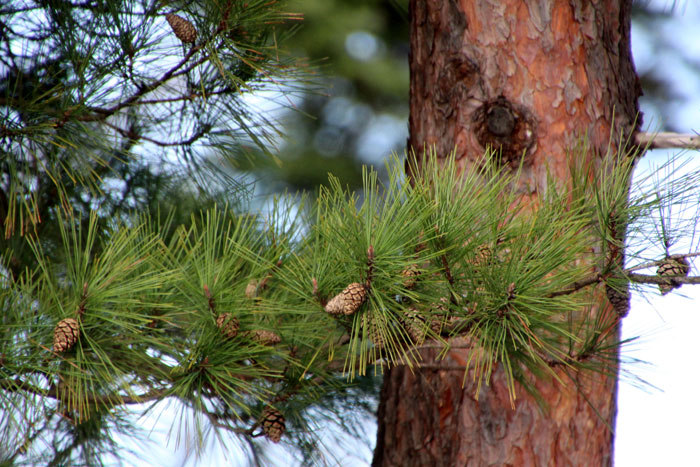
Needles of wild red pine (Pinus densiflora) from mountain ravines of central Japan
Step 2 - iron kettle, about 2 hours
Boiled in alkaline ionised water
Step 3 - plant matter removed
Needles and all solids taken out of the decoction
Step 4 - to about 78 Brix
The liquid is concentrated over an extended period
Step 5 - every lot
Colour, appearance, Brix, pH, moisture, arsenic, heavy metals, pesticide residues, plate count, coliforms
Step 6 - ESR method
Superoxide, hydroxyl radical and singlet oxygen scavenging, reported in units per gram
The grade on this page. Other grades, where available, are specified on request.
Example lot values are published in the developer's guide below. They are an example, not a specification; your lot's CoA governs.
A Japanese trading company selling directly to brand owners and contract manufacturers. No distributor layer between you and the documents.
Every shipment travels with the Certificate of Analysis of its own lot, with the measured values and the full safety panel.
A small first order lets you run a pilot batch before committing to bulk. Larger volumes are quoted by volume and delivery terms.
For registered companies developing a product. Tell us the format you plan and we will say honestly what to expect.
After payment is received. Freight quoted on request. Specification and SDS before you order, CoA with the goods.
If you are comparing ingredients for a new SKU, these questions separate one material from another quickly.
The material is a food ingredient in Japan. Registration of a finished product on your market stays with the brand; for the EU, the novel food status of this material has not been checked by us.
This is a viscous concentrate, not a powder. It suits liquid supplements, softgels and stick sachets; tell us the format and we will say what to expect.
They are not among the documents we hold today for this material. Say so early if your market requires them.
Wild raw material and a traditional process mean colour, aroma and composition move slightly between harvests. The specification limits and the CoA of your lot are the reference.
Specification, SDS and a reference CoA are available before the order; the CoA of your lot ships with the goods.
What each component is, what the processing changes, and what published research on the raw material has examined. No health claims; references on request.
Red Pine Needle Extract (Concentrate) is a single-ingredient Japanese botanical for brands that want a heritage story with a traceable production method. It is not a standardised dry fraction: it is the whole hot-water extract of wild red pine needles, reduced in iron kettles until it reaches about 78 Brix. The producer has made extracts this way for generations and makes the concentrate, not a powder.
Formats that fit the material: liquid supplements taken by the spoon, softgels filled with the concentrate, stick sachets and functional drinks. The producer's reference intake is 2 g per day, which makes a 60 g unit a one-month supply; the dosage of a finished product is set by the brand for its market. Dry formats are possible in principle but need a drying or carrier step, which changes the product; tell us if that is your direction.
Finished products can be filled and packed at our own Tomioka Plant in Gunma; the ingredient also combines in a Japanese botanical range with Ginkgo biloba leaf extract and S-allyl cysteine garlic extract.
Pinus densiflora, the Japanese red pine (akamatsu), grows across Japan, Korea and north-east China. Its needles have a long history of use in East Asia as a tea and as an ingredient of traditional preparations. The producer's raw material is wild red pine from mountain ravines above 600 m, harvested rather than farmed.
According to PubMed, two studies from a Korean university group analysed Pinus densiflora needle extracts prepared with different solvents. Hot-water extraction gave the highest proanthocyanidin level among the methods compared, and the radical-scavenging activity of the hot-water extract in DPPH assays was related to both polymeric proanthocyanidins and monomeric catechins (Park et al., Nutr Res Pract 2011; Kim et al., Nutr Res Pract 2010). These are laboratory findings on the needle as a raw material, not results for a finished product.
The producer reports antioxidant activity of the concentrate by the ESR method as superoxide, hydroxyl radical and singlet oxygen scavenging values per gram; the specification lists SOD activity of 5.5 x 10^4 units/g. In a 2017 programme with a Japanese university medical faculty and a prefectural food research centre, the producer compared the antioxidant activity of the concentrate made with alkaline ionised water against its earlier process, and ran a one-month observation in 25 adults aged 30 to 60 taking 2 g per day, measuring vascular-age indices with a pulse-wave device before and after. The study summary is available to B2B buyers on request; we do not make health claims from it on this page.
Decoction extracts the water-soluble fraction of the needle; the long reduction removes water and leaves a dense, acidic (pH about 4.2) concentrate with 73 to 78 Brix. The result is shelf-stable for 24 months unopened without preservatives. Volatile pine aroma is partly retained, which is why the concentrate smells of the forest rather than of a neutral extract.
Pine bark extracts on the market are usually standardised dry fractions of oligomeric proanthocyanidins from the bark of maritime pine (Pinus pinaster). This product is the whole hot-water extract of the needles of a different species, sold as a liquid, with its SOD activity and contaminant panel reported per lot rather than a standardised OPC percentage.
Start at the minimum order. Free sample. Specification, SDS and lot CoA on request.
Request a sample or quotationRed Pine Needle Extract (Concentrate) is a single-ingredient Japanese botanical for brands that want a heritage story with a traceable production method. It is not a standardised dry fraction: it is the whole hot-water extract of wild red pine needles, reduced in iron kettles until it reaches about 78 Brix. The producer has made extracts this way for generations and makes the concentrate, not a powder.
Formats that fit the material: liquid supplements taken by the spoon, softgels filled with the concentrate, stick sachets and functional drinks. The producer's reference intake is 2 g per day, which makes a 60 g unit a one-month supply; the dosage of a finished product is set by the brand for its market. Dry formats are possible in principle but need a drying or carrier step, which changes the product; tell us if that is your direction.
Finished products can be filled and packed at our own Tomioka Plant in Gunma; the ingredient also combines in a Japanese botanical range with Ginkgo biloba leaf extract and S-allyl cysteine garlic extract.
Pinus densiflora, the Japanese red pine (akamatsu), grows across Japan, Korea and north-east China. Its needles have a long history of use in East Asia as a tea and as an ingredient of traditional preparations. The producer's raw material is wild red pine from mountain ravines above 600 m, harvested rather than farmed.
According to PubMed, two studies from a Korean university group analysed Pinus densiflora needle extracts prepared with different solvents. Hot-water extraction gave the highest proanthocyanidin level among the methods compared, and the radical-scavenging activity of the hot-water extract in DPPH assays was related to both polymeric proanthocyanidins and monomeric catechins (Park et al., Nutr Res Pract 2011; Kim et al., Nutr Res Pract 2010). These are laboratory findings on the needle as a raw material, not results for a finished product.
The producer reports antioxidant activity of the concentrate by the ESR method as superoxide, hydroxyl radical and singlet oxygen scavenging values per gram; the specification lists SOD activity of 5.5 x 10^4 units/g. In a 2017 programme with a Japanese university medical faculty and a prefectural food research centre, the producer compared the antioxidant activity of the concentrate made with alkaline ionised water against its earlier process, and ran a one-month observation in 25 adults aged 30 to 60 taking 2 g per day, measuring vascular-age indices with a pulse-wave device before and after. The study summary is available to B2B buyers on request; we do not make health claims from it on this page.
Decoction extracts the water-soluble fraction of the needle; the long reduction removes water and leaves a dense, acidic (pH about 4.2) concentrate with 73 to 78 Brix. The result is shelf-stable for 24 months unopened without preservatives. Volatile pine aroma is partly retained, which is why the concentrate smells of the forest rather than of a neutral extract.
Pine bark extracts on the market are usually standardised dry fractions of oligomeric proanthocyanidins from the bark of maritime pine (Pinus pinaster). This product is the whole hot-water extract of the needles of a different species, sold as a liquid, with its SOD activity and contaminant panel reported per lot rather than a standardised OPC percentage.

No. It is a viscous black-brown liquid concentrate of about 78 Brix, filled as it comes from the kettle. It suits liquid supplements, softgels and stick sachets. If you need a dry format, tell us; it would require a drying or carrier step and becomes a different product.
100% hot-water extract of wild red pine needles (Pinus densiflora). No additives, carrier, preservative, sweetener or solvent. The Japanese 28-item allergen list and the 8-crop GMO list are not applicable to this material.
Specification, SDS and a reference Certificate of Analysis before you order; the CoA of your lot ships with the goods. The specification covers colour, appearance, Brix, pH, moisture, arsenic, heavy metals, four pesticide residues (BHC, DDT, aldrin and dieldrin, endrin), total plate count and coliforms. Antioxidant activity (SOD) is reported as a reference value.
Pine bark extracts are standardised dry proanthocyanidin fractions from the bark of maritime pine (Pinus pinaster). This is the whole hot-water extract of the needles of Japanese red pine (Pinus densiflora), sold as a liquid concentrate with a reported SOD activity and a full contaminant panel rather than a standardised OPC percentage.


