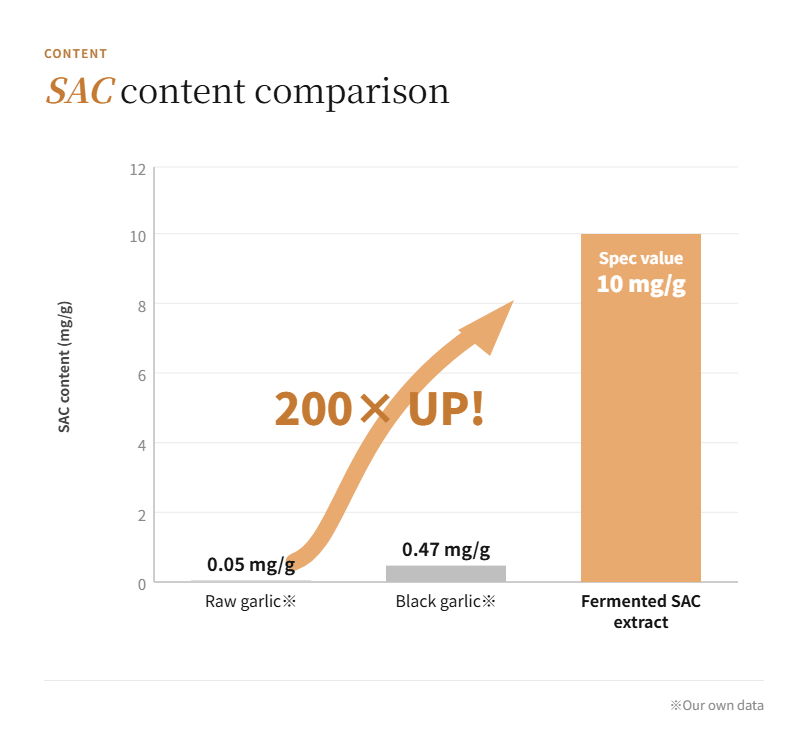
This is a fermented garlic extract supplied as a powder and standardized on one functional compound - S-allyl-L-cysteine (SAC), the organosulfur amino acid that aged and fermented garlic is known for. SAC is almost absent in raw garlic and accumulates during aging and fermentation. Through a proprietary fermentation process, this material reaches a guaranteed SAC content of 10 mg/g or more (1% or more) - more than 200 times the level of ordinary raw garlic. The extract is 100% garlic, with no food additives.
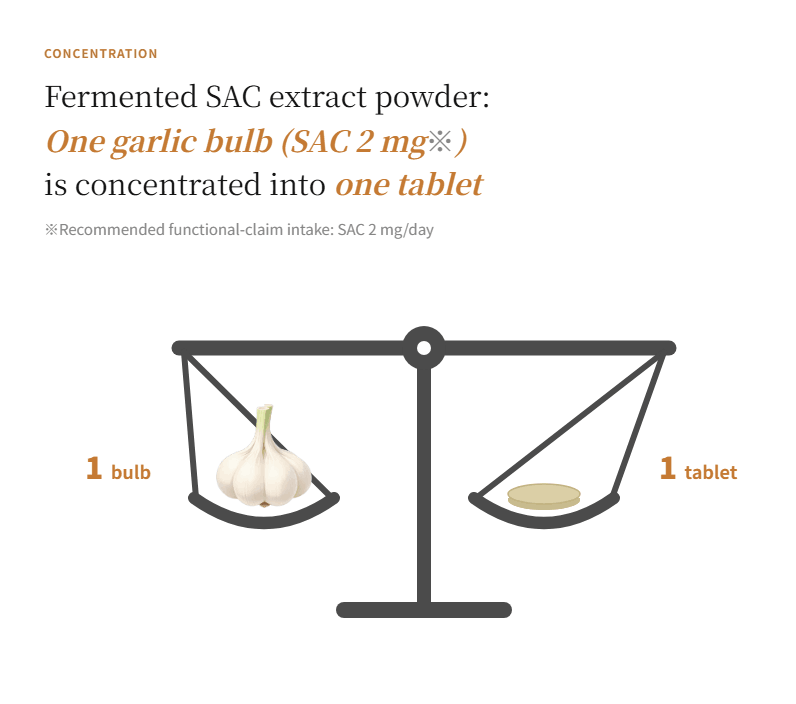
In short, it concentrates the SAC of one whole raw garlic bulb (about 2 mg) into roughly a single tablet, so a finished product can deliver a meaningful, consistent dose of SAC at a few hundred milligrams of powder.
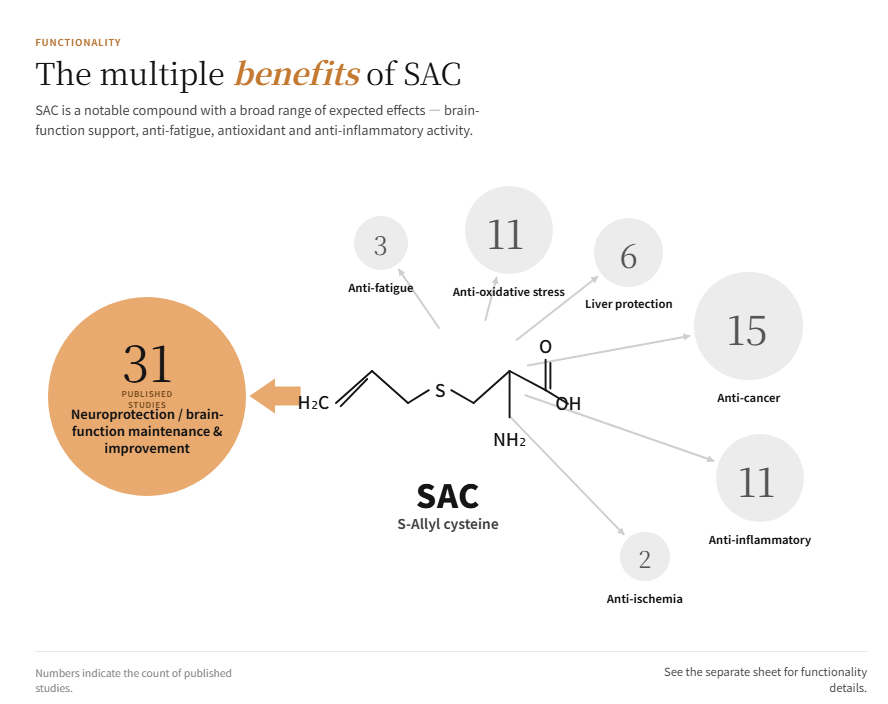
Garlic contains many active substances - allicin, alliin, gamma-glutamyl-S-allylcysteine and others - but SAC is the compound with the largest body of published functional research. Unlike allicin, which is odorous and unstable, SAC is stable and water-soluble, which is why a fermented garlic material standardized on SAC gives a reproducible active for formulation rather than a moving target.
Garlic odor is the main barrier to using garlic actives in everyday products. Here the characteristic garlic odor and taste are reduced through a dedicated low-odor process, so high SAC content and low odor are achieved together. The powder is free-flowing with good processability, which suits capsules, tablets, sticks and beverages.
The extract is produced in Japan by an integrated process: hot-water extraction of selected garlic, a proprietary fermentation step that builds the SAC content, filtration, concentration, flash sterilization and spray-drying to a fine powder, with a low-odor (deodorization) technology applied so that high SAC and reduced garlic odor are delivered together. Quality is verified lot by lot, and a test report (Certificate of Analysis) is supplied with each shipment.
Powder supplied in 1 kg packs and up (polyethylene inner bag). Shelf life is 3 years from manufacture, unopened. Store in a cool, dark, low-humidity place; after opening, use as soon as possible.
SAC is the principal stable, bioavailable bioactive of aged and fermented garlic. In the peer-reviewed literature, garlic's odorous compound allicin is unstable and decomposes during processing, whereas SAC is odorless, water-soluble and stable - S-allylcysteine remained stable for 12 months at ambient temperature in one analytical study - which is why allicin-free garlic preparations are standardized and characterized on SAC as the active marker (Lawson and Gardner, J Agric Food Chem, 2005; Amagase, J Nutr, 2006).
SAC has a favorable pharmacokinetic profile that supports low, consistent dosing. In animal studies it is well absorbed with high oral bioavailability - greater than 90% in rats and dogs, and 88-95.8% across the sulfur amino acids of aged garlic - with a long elimination half-life driven by extensive renal reabsorption (Amano et al., Drug Metabolism and Disposition, 2015; Nakamoto et al., Experimental and Therapeutic Medicine, 2025).
SAC scavenges reactive oxygen species and activates Nrf2, the master regulator of the cellular redox state, with documented antioxidant, anti-inflammatory and neuroprotective activity in preclinical models, including Nrf2 activation in cerebral cortex (Colin-Gonzalez et al., Oxidative Medicine and Cellular Longevity, 2012; Colin-Gonzalez et al., Neurochemistry International, 2015). This redox biology is the mechanistic basis most often cited for SAC's effects on brain and cellular stress.
Beyond fatigue, the wider SAC and aged-garlic literature is deep. Standardized aged garlic extract delivering SAC has been studied in randomized controlled trials for blood pressure in hypertension (Ried et al., European Journal of Clinical Nutrition, 2013; Serrano et al., Nutrients, 2023) and, more recently, for aerobic fitness and quicker recovery in endurance athletes (Ried et al., Experimental and Therapeutic Medicine, 2025). This is class-level evidence about the compound SAC and aged garlic, not a claim about this specific product; permitted claims depend on the destination market.
This fermented SAC extract has been tested directly. In a randomized, double-blind, placebo-controlled study, 22 healthy adults who routinely felt fatigued took the fermented SAC extract at 200 mg/day or placebo for 4 weeks and were assessed under a cognitive-load task; the SAC group showed a statistically significant reduction in the primary measure, the sense of fatigue, versus placebo (Matsunaga, Uryu and Maru, Japanese Pharmacology and Therapeutics, 2021). In Japan this supports a dual functional-food claim for reducing temporary mental and physical fatigue; outside Japan, use the material as a structure-function ingredient and confirm claims for your market.
Garlic odor has historically been the single biggest barrier to consumer garlic products. A deodorized SAC powder removes that penalty, enabling pleasant capsules, sticks and beverages - a practical advantage that commodity garlic extracts matching the SAC percentage on paper do not provide.

It is a fermented garlic extract supplied as a powder and standardized on S-allyl-L-cysteine (SAC), the stable organosulfur active of aged and fermented garlic. It is 100% garlic extract with no additives, deodorized, water-soluble, and guaranteed to contain SAC 10 mg/g or more.
It is standardized to SAC 10 mg/g or more (1% or more) by HPLC - more than 200 times the SAC of ordinary raw garlic (about 0.05 mg/g) and well above black garlic (about 0.47 mg/g). Standardizing on SAC, rather than on unstable allicin, gives a reproducible active for formulation.
The reference intake is 100-200 mg/day, which delivers about 2 mg of SAC per day. In Japan this supports a dual functional-food claim for reducing temporary mental and physical fatigue (brain fatigue). Outside Japan it is used as a structure-function anti-fatigue and energy ingredient; confirm permitted claims for your market.
It is supplied as a bulk raw material in 1 kg packs and up, with a 3-year shelf life unopened, stored cool, dark and dry. In Japan it fits the functional-food route for fatigue; in the United States it is used as a dietary-supplement ingredient; in the EU, garlic extract is an established food. Confirm classification and claims for the destination market.


