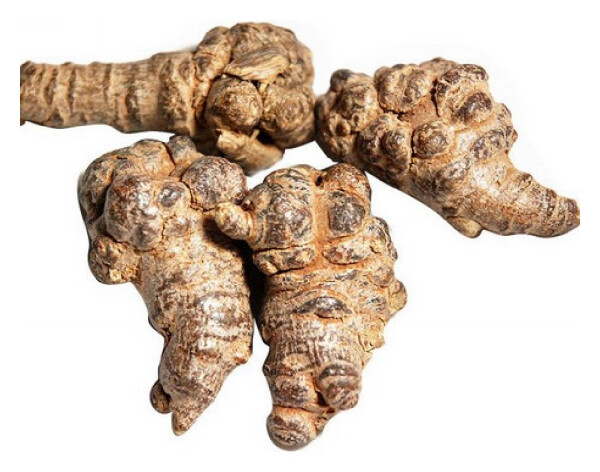
Panax notoginseng (tienchi, sanqi) root extract powder, standardized to min. 10% ginsenosides Rg1 + Rb1 by HPLC, with a notoginsenoside R1 identity test in the specification. The root is grown in China; extraction, spray-drying and packing are done in Japan, with isomaltodextrin, a soluble dietary fibre, as the carrier.
Tell us what you are developing and which documents you need. We reply from Japan within one working day with the product specification, SDS and the CoA of the current lot.
Panax notoginseng root grown in China is extracted in Japan with 30% ethanol at 50 C. The filtered extract is concentrated at max. 65 C, combined with isomaltodextrin and spray-dried, then sieved, passed over magnets and packed. The specification fixes ginsenosides Rg1 + Rb1 at min. 10% and requires a positive identity test for notoginsenoside R1.
Step 1 · root, China
Panax notoginseng root, received and weighed
Step 2 · 30% ethanol, 50 C
Saponins extracted from the root
Step 3 · 100-120 mesh
Solids removed from the extract
Step 4 · max. 65 C
Extract concentrated at a moderate temperature
Step 5 · isomaltodextrin
Soluble dietary fibre added, then dried to powder
Step 6 · 60 mesh, 10,000 gauss
14 permanent magnets remove metal particles
Step 7 · 1 kg aluminium bags
Rg1 + Rb1 by HPLC, R1 identity by TLC, contaminants and microbiology
The grade on this page. Other grades, where available, are specified on request.
Example lot values are published in the developer's guide below. They are an example, not a specification; your lot's CoA governs.
A Japanese trading company selling directly to brand owners and contract manufacturers. No distributor layer between you and the documents.
Every shipment travels with the Certificate of Analysis of its own lot, with the measured values and the full safety panel.
A small first order lets you run a pilot batch before committing to bulk. Larger volumes are quoted by volume and delivery terms.
For registered companies developing a product. Tell us the format you plan and we will say honestly what to expect.
After payment is received. Freight quoted on request. Specification and SDS before you order, CoA with the goods.
If you are comparing ingredients for a new SKU, these questions separate one material from another quickly.
Here the specification counts two ginsenosides, Rg1 and Rb1, measured by HPLC, at min. 10% combined. Other offers may state total saponins or a different set of compounds, so compare the method and the compounds named, not only the percentage.
Notoginsenoside R1 is the saponin used as the identity marker for this root. The specification requires a positive R1 test, so ask to see it on the CoA of the lot you receive.
The powder is light, with a low bulk density. In one capsule project at 100 mg per capsule, the contract manufacturer found it hard to dose evenly. For small fill weights, plan a granulation or blending step.
The powder contains isomaltodextrin, a soluble dietary fibre made from corn, potato and sweet potato starch. Check how your market lists it, and ask before you order if you need a non-GMO statement for the carrier.
The root is grown in China and extracted, dried and packed in Japan. Rules of origin for processed botanicals differ by country, so confirm the classification with your customs broker before you plan duties.
Some markets permit only listed botanicals or treat concentrated extracts as novel foods. Check the status for your category before launch; registration of the finished product sits with the brand owner or importer.
Halal and kosher certificates are not part of the product documents. Supplements for the UAE need halal, so raise it before you plan a UAE launch.
What each component is, what the processing changes, and what published research on the raw material has examined. No health claims; references on request.
This powder is a standardized extract of Panax notoginseng root, also known as tienchi, sanqi or sanchi ginseng. The specification fixes ginsenosides Rg1 and Rb1 at min. 10% combined, measured by HPLC, and requires a positive identity test for notoginsenoside R1, the saponin used to recognise this root. The root is grown in China; extraction, spray-drying and packing are done in Japan, and in Japan the powder is classified as a food, not a pharmaceutical.
The producer's usage example is 200 mg of powder per day in tablets. At min. 10%, that amount carries at least 20 mg of Rg1 + Rb1, and 1 kg covers 5,000 such daily amounts.
The producer documents tablets, capsules, powdered drinks, soups and jelly, and reports a reduced ginseng-type odour. The carrier, isomaltodextrin, is a soluble dietary fibre. The powder is light: in one low-dose capsule project, at 100 mg per capsule, even dosing was difficult, so for small fill weights plan a granulation or blending step with your contract manufacturer.
A reference lot made in 2021 measured ginsenosides Rg1 + Rb1 at 11.4% and loss on drying at 1.8%, with a positive notoginsenoside R1 test. Heavy metals were 10 ppm or less, arsenic 2 ppm or less, total plate count and yeasts and moulds 20 CFU/g or less each, and coliforms negative. These are example values, not a specification; the CoA of your lot governs.
Need finished tablets or capsules rather than powder? We also make OEM supplements in Japan: see OEM supplements. Other standardized botanical extracts: Ginkgo Biloba Leaf Extract and Red Pine Needle Extract (Concentrate).
To discuss price, volume or your application, or to request the specification or a sample, use the request form on this page.
Panax notoginseng (Burk.) F.H. Chen is a member of the ginseng genus, Panax. It is known as sanqi or tianqi in China, grows mainly in the southwest of the country and is widely used in traditional Chinese medicine. More than 200 compounds have been isolated from the plant, among them saponins, flavonoids and cyclopeptides (Journal of Ethnopharmacology, 2016). Cultivation is concentrated in Wenshan Prefecture in Yunnan (BMC Plant Biology, 2020).
Panax notoginseng and Panax ginseng both contain ginsenosides, but their chemistry differs. A comparative review found more saponins, volatile oil and polyacetylenes in notoginseng, and more polysaccharides and amino acids in Panax ginseng (Pharmacological Research, 2020). Chemical profiling can tell the Panax species apart by their marker saponins, with a notoginsenoside among the most important markers (Molecules, 2023). The specification of this powder uses notoginsenoside R1 for its identity test.
Notoginseng saponins are a mixture of dammarane-type triterpene saponins, and chromatography, most often HPLC, is the main tool used to identify and measure them (Journal of Ethnopharmacology, 2019). Around 270 saponins have been identified in the plant (Phytochemistry, 2024), and notoginsenoside R1 and ginsenosides Rg1, Rb1, Rd and Re are among the major ones (Phytomedicine, 2022). This specification names two of them, Rg1 and Rb1, and the method used to measure them.
Processing changes notoginseng chemistry. When the root is steamed, these major saponins decrease and minor ginsenosides such as Rg3, Rk1 and Rg5 form (same study, Phytomedicine, 2022). This extract is made at moderate temperatures, 50 C for extraction and max. 65 C for concentration.
Notoginseng saponins have low oral bioavailability. Gut bacteria remove their sugar units, a step called deglycosylation, and produce metabolites such as compound K, protopanaxatriol and protopanaxadiol; this was shown by incubating the saponins with human gut microbiota (Journal of Pharmaceutical and Biomedical Analysis, 2017) and is reviewed in Journal of Ethnopharmacology, 2025.
Arsenic in the soil of the main growing area is a known quality issue for notoginseng, and the plant takes up arsenic from contaminated soil into its roots (Chemosphere, 2012). The specification of this powder limits arsenic to max. 5 ppm and heavy metals to max. 20 ppm, and the raw root is screened for 120 pesticide residues.
Laboratory and animal research has examined Panax notoginseng in relation to the cardiovascular and immune systems, among other topics (review: Journal of Ethnopharmacology, 2016). This research was not conducted on this product and is not a claim for it; the statements a finished product may carry are set by the rules of its market.
Start at the minimum order. Free sample. Specification, SDS and lot CoA on request.
Request a sample or quotationThis powder is a standardized extract of Panax notoginseng root, also known as tienchi, sanqi or sanchi ginseng. The specification fixes ginsenosides Rg1 and Rb1 at min. 10% combined, measured by HPLC, and requires a positive identity test for notoginsenoside R1, the saponin used to recognise this root. The root is grown in China; extraction, spray-drying and packing are done in Japan, and in Japan the powder is classified as a food, not a pharmaceutical.
The producer's usage example is 200 mg of powder per day in tablets. At min. 10%, that amount carries at least 20 mg of Rg1 + Rb1, and 1 kg covers 5,000 such daily amounts.
The producer documents tablets, capsules, powdered drinks, soups and jelly, and reports a reduced ginseng-type odour. The carrier, isomaltodextrin, is a soluble dietary fibre. The powder is light: in one low-dose capsule project, at 100 mg per capsule, even dosing was difficult, so for small fill weights plan a granulation or blending step with your contract manufacturer.
A reference lot made in 2021 measured ginsenosides Rg1 + Rb1 at 11.4% and loss on drying at 1.8%, with a positive notoginsenoside R1 test. Heavy metals were 10 ppm or less, arsenic 2 ppm or less, total plate count and yeasts and moulds 20 CFU/g or less each, and coliforms negative. These are example values, not a specification; the CoA of your lot governs.
Need finished tablets or capsules rather than powder? We also make OEM supplements in Japan: see OEM supplements. Other standardized botanical extracts: Ginkgo Biloba Leaf Extract and Red Pine Needle Extract (Concentrate).
To discuss price, volume or your application, or to request the specification or a sample, use the request form on this page.
Panax notoginseng (Burk.) F.H. Chen is a member of the ginseng genus, Panax. It is known as sanqi or tianqi in China, grows mainly in the southwest of the country and is widely used in traditional Chinese medicine. More than 200 compounds have been isolated from the plant, among them saponins, flavonoids and cyclopeptides (Journal of Ethnopharmacology, 2016). Cultivation is concentrated in Wenshan Prefecture in Yunnan (BMC Plant Biology, 2020).
Panax notoginseng and Panax ginseng both contain ginsenosides, but their chemistry differs. A comparative review found more saponins, volatile oil and polyacetylenes in notoginseng, and more polysaccharides and amino acids in Panax ginseng (Pharmacological Research, 2020). Chemical profiling can tell the Panax species apart by their marker saponins, with a notoginsenoside among the most important markers (Molecules, 2023). The specification of this powder uses notoginsenoside R1 for its identity test.
Notoginseng saponins are a mixture of dammarane-type triterpene saponins, and chromatography, most often HPLC, is the main tool used to identify and measure them (Journal of Ethnopharmacology, 2019). Around 270 saponins have been identified in the plant (Phytochemistry, 2024), and notoginsenoside R1 and ginsenosides Rg1, Rb1, Rd and Re are among the major ones (Phytomedicine, 2022). This specification names two of them, Rg1 and Rb1, and the method used to measure them.
Processing changes notoginseng chemistry. When the root is steamed, these major saponins decrease and minor ginsenosides such as Rg3, Rk1 and Rg5 form (same study, Phytomedicine, 2022). This extract is made at moderate temperatures, 50 C for extraction and max. 65 C for concentration.
Notoginseng saponins have low oral bioavailability. Gut bacteria remove their sugar units, a step called deglycosylation, and produce metabolites such as compound K, protopanaxatriol and protopanaxadiol; this was shown by incubating the saponins with human gut microbiota (Journal of Pharmaceutical and Biomedical Analysis, 2017) and is reviewed in Journal of Ethnopharmacology, 2025.
Arsenic in the soil of the main growing area is a known quality issue for notoginseng, and the plant takes up arsenic from contaminated soil into its roots (Chemosphere, 2012). The specification of this powder limits arsenic to max. 5 ppm and heavy metals to max. 20 ppm, and the raw root is screened for 120 pesticide residues.
Laboratory and animal research has examined Panax notoginseng in relation to the cardiovascular and immune systems, among other topics (review: Journal of Ethnopharmacology, 2016). This research was not conducted on this product and is not a claim for it; the statements a finished product may carry are set by the rules of its market.

It is an extract of Panax notoginseng root, made with 30% ethanol and spray-dried on isomaltodextrin, a soluble dietary fibre. The root is grown in China; extraction, drying and packing are done in Japan. The specification sets ginsenosides Rg1 + Rb1 at min. 10% by HPLC and requires a positive identity test for notoginsenoside R1. In Japan the powder is classified as a food, not a pharmaceutical.
The minimum order is 1 kg at 1,050 USD/kg, in 1 kg units; larger orders are quoted by volume, and freight is quoted on request. The powder is packed in 1 kg aluminium zip bags. Payment is 100% prepayment by SWIFT or Stripe, and orders ship from Japan 1-1.5 weeks after payment. Registered companies developing a product can request a free 10 g sample.
Ginsenosides Rg1 + Rb1 min. 10% (HPLC), notoginsenoside R1 positive (TLC), loss on drying max. 10% (provisional limit), heavy metals max. 20 ppm, arsenic max. 5 ppm, total plate count max. 1,000 CFU/g, yeasts and moulds max. 300 CFU/g and coliforms negative; the raw root is screened for 120 pesticide residues. Shelf life is 5 years from manufacture, unopened, stored at 15-25 C away from light and humidity. The specification is available before you order; the lot CoA and SDS are available on request.
It is a light powder with a low bulk density. In a capsule project at 100 mg per capsule, the contract manufacturer found it hard to dose evenly, so for small fill weights plan a granulation or blending step. The producer documents tablets, capsules, powdered drinks, soups and jelly, with a usage example of 200 mg of powder per day in tablets, which carries at least 20 mg of Rg1 + Rb1.


