100% prepayment by SWIFT or Stripe. Larger orders quoted by volume; freight quoted on request
Functional ingredient·
Coenzyme Q10 (ubiquinone)
·Japan

Water-Soluble CoQ10 40%

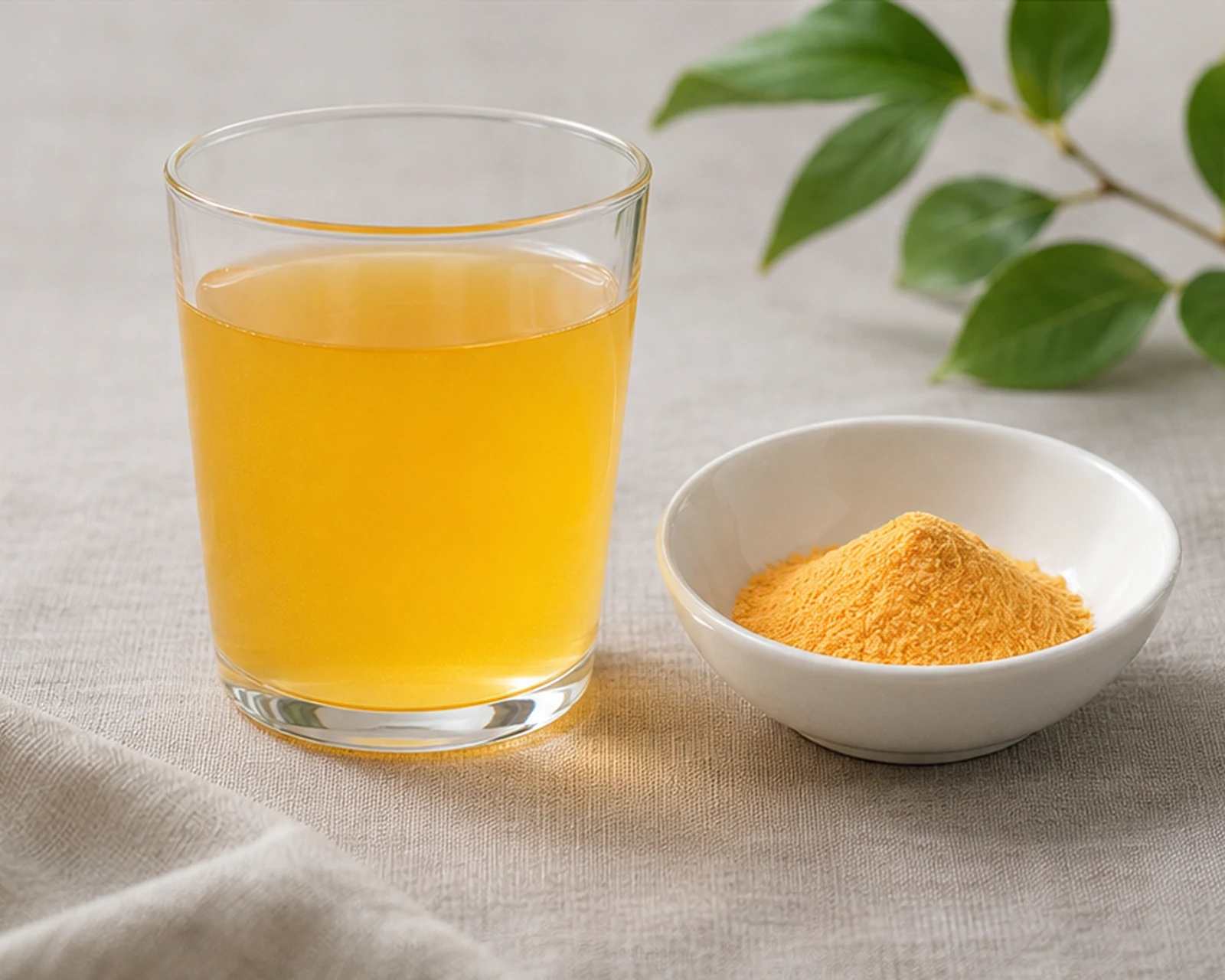
A coenzyme Q10 powder with not less than 39.2% CoQ10, micronised to particles of about 0.2 micron so that it disperses evenly in water. The CoQ10 is carried on maltodextrin, modified starch and glycerin, and the powder keeps for 30 months in a 1 kg aluminium bag.
1 kg
Minimum order
1,540.62 USD/kg
MOQ price
20 g
Free sample
Ships from Japan 1-1.5 weeks after paymentFreight quoted on requestSWIFT or Stripe
Water-Soluble CoQ10 40%
Specification · lot CoA

Key figures at a glance

Your lot's CoA governs
CoQ10 content
min. 39.2%
nominal 40%; 250 mg of powder gives about 100 mg
Particle size
about 0.2 micron
micronised dispersion
Water dispersibility
no sediment
none of 1 mm or more after 30 minutes
Moisture
max. 5%
yellowish white to orange-yellow powder
Heavy metals
max. 20 ppm
as Pb; arsenic max. 2 ppm as As2O3
Total plate count
max. 1,000 CFU/g
coliforms negative per 2 g
Lot-specific values are measured and reported for every lot. Natural raw materials move with season and harvest, so we give you the figures of the lot you actually receive, not one fixed number.
What it is
Coenzyme Q10 (ubiquinone) powder with not less than 39.2% CoQ10, micronised to about 0.2 micron and carried on maltodextrin, modified starch and glycerin
Form
Yellowish white to orange-yellow powder that disperses evenly in water. For stick packs, powder blends, tablets and capsules
Shelf life
30 months from production, stored in a cool place protected from light
Packing
1 kg aluminium bag. MOQ 1 kg
Lead time
Ships from Japan 1-1.5 weeks after payment. Lot CoA with every shipment
Terms
100% prepayment by SWIFT or Stripe. Larger orders quoted by volume; freight quoted on request
Price and documents

Request a price, specification or sample

Tell us what you are developing and which documents you need. We reply from Japan within one working day with the product specification, SDS and the CoA of the current lot.

Free sample for registered companies developing a product
Volume quotation for orders above the minimum
Specification, SDS and lot CoA on request

Request a sample or quotation

All fields required. Business email only.
Process

How it is made

Coenzyme Q10 behaves like an oil and does not mix with water on its own. In this grade it is micronised to particles of about 0.2 micron and carried on maltodextrin, modified starch and glycerin, so the finished powder disperses in water. Every lot is released against the specification below.

The dispersibility test is simple to repeat in your own lab: the powder is dispersed evenly in purified water and left to stand for 30 minutes, and no insoluble matter or sediment of 1 mm or more may be seen.

Micronisation

Step 1 · about 0.2 micron

Coenzyme Q10 is reduced to fine particles and carried on maltodextrin, modified starch and glycerin

Content and appearance

Step 2 · CoQ10 min. 39.2%

Yellowish white to orange-yellow powder

Dispersibility test

Step 3 · 30 minutes in purified water

No insoluble matter or sediment of 1 mm or more

Moisture

Step 4 · max. 5%

Checked on every lot

Contaminants and microbiology

Step 5 · safety panel

Arsenic max. 2 ppm, heavy metals max. 20 ppm, total plate count max. 1,000 CFU/g, coliforms negative per 2 g

Packing and lot documents

Step 6 · 1 kg aluminium bag

Certificate of Analysis of the lot travels with the goods

Specification

Specification at a glance

The grade on this page. Other grades, where available, are specified on request.

Identity and composition

  • Product: Water-Soluble CoQ10 40%, a water-dispersible coenzyme Q10 powder
  • Active: coenzyme Q10 as ubiquinone, CAS 303-98-0
  • Declaration: coenzyme Q10, maltodextrin, modified starch, glycerin
  • CoQ10 content: not less than 39.2% (nominal 40%)
  • Appearance: yellowish white to orange-yellow powder

Process and peptide profile

  • Form: micronised coenzyme Q10 on a carrier of maltodextrin, modified starch and glycerin
  • Particle size: about 0.2 micron
  • Water dispersibility: disperses evenly in purified water; no insoluble matter or sediment of 1 mm or more after 30 minutes
  • CoQ10 per serving: about 75 mg of powder for 30 mg of CoQ10, 125 mg for 50 mg, 250 mg for 100 mg

Analytical specification

  • Coenzyme Q10 content: not less than 39.2%
  • Moisture: not more than 5%
  • Appearance: yellowish white to orange-yellow powder
  • Water dispersibility: no insoluble matter or sediment of 1 mm or more after 30 minutes in purified water

Contaminants, microbiology and safety

  • Arsenic (as As2O3): not more than 2 ppm
  • Heavy metals (as Pb): not more than 20 ppm
  • Total plate count: not more than 1,000 CFU/g
  • Coliforms: negative per 2 g

Shelf life, storage and packing

  • Shelf life: 30 months from production
  • Storage: cool place, protected from light
  • Packing: 1 kg aluminium bag
  • MOQ: 1 kg
  • Lead time: ships from Japan 1-1.5 weeks after payment; freight quoted on request
  • Documents: Certificate of Analysis of the lot with every shipment
  • Samples: free 20 g evaluation sample for registered companies developing a product
SPEC
Product specification, PDF. On request through the form.
CoA
Certificate of Analysis. One for every lot, ships with the goods.
SDS
Safety Data Sheet. On request through the form.

Example lot values are published in the developer's guide below. They are an example, not a specification; your lot's CoA governs.

Direct from Japan

Working with us

A Japanese trading company selling directly to brand owners and contract manufacturers. No distributor layer between you and the documents.

A CoA for the lot you receive

Every shipment travels with the Certificate of Analysis of its own lot, with the measured values and the full safety panel.

Start at the minimum order

A small first order lets you run a pilot batch before committing to bulk. Larger volumes are quoted by volume and delivery terms.

Free sample

For registered companies developing a product. Tell us the format you plan and we will say honestly what to expect.

Ships from Japan in 1-1.5 weeks

After payment is received. Freight quoted on request. Specification and SDS before you order, CoA with the goods.

Buyer's checklist

What to ask any supplier

If you are comparing ingredients for a new SKU, these questions separate one material from another quickly.

How much CoQ10 will one daily serving carry?

Fix the CoQ10 amount first, then the powder weight. At about 40% CoQ10, 50 mg of CoQ10 takes about 125 mg of powder and 100 mg takes about 250 mg, which decides capsule size, tablet weight or stick fill.

Is that amount inside the frame of your market?

Limits differ. In Australia, listed medicines for internal use may provide no more than 300 mg of ubidecarenone (CoQ10) a day and need a warfarin warning on the label. The EU has no common maximum; Germany allowed up to 100 mg a day in food supplements in a 2014 general ruling, with label warnings.

Will your label make a health claim?

In the EU no health claim for coenzyme Q10 is authorised: EFSA did not consider the claims it assessed in 2010 substantiated. The brand confirms claims and registration for its own market.

Is your product a drink or a powder mixed into a liquid?

The dispersibility specification is measured in purified water over 30 minutes. Test the powder in your own base, at your pH, mineral content, temperature and storage time, before you fix the formula.

How will the ingredients be named on your label?

The declaration is coenzyme Q10, maltodextrin, modified starch and glycerin. How the carrier components are named on a finished label follows the rules of your market; check it with your regulatory team.

Which certificates does your market or retailer require?

Tell us at the start if you need halal, kosher, non-GMO or allergen statements, so we can confirm what is available for this grade before you plan the launch. In the UAE, supplements need a halal certificate.

For product developers

The developer's guide

What each component is, what the processing changes, and what published research on the raw material has examined. No health claims; references on request.

Water-dispersible coenzyme Q10 for powder, stick and tablet formats

Coenzyme Q10 is usually sold as a crystalline powder or as an oil suspension in softgels, because on its own it does not mix with water. Water-Soluble CoQ10 40% is a dispersible grade: the CoQ10 is micronised and carried on maltodextrin, modified starch and glycerin, so the powder spreads evenly through water. That makes room for formats where plain CoQ10 is awkward, such as stick packs and powder blends that are stirred into a glass of water.

The name follows trade usage. Strictly, the powder disperses in water rather than forming a true solution, and the specification describes it that way.

Why formulators choose this grade

  • It goes where oil cannot. The powder disperses in water, so CoQ10 can sit in stick packs, powder drinks and tablets without an oil carrier.
  • Absorption with or without a meal. In a single-dose human study, tablets made with this grade were compared with a regular coenzyme Q10 softgel, taken fasting and after a meal. Data for this grade show that total exposure (AUC) after a meal was about 3.4 times that of the softgel.
  • A track record in Japan. Japanese Foods with Function Claims notifications using this ingredient state that coenzyme Q10 has been reported to reduce the temporary feeling of fatigue in daily life and to improve sleep quality in healthy people under transient stress.

Details, study designs and the limits of these statements are in the developer's guide below.

Where it fits

  • Stick packs and sachets of powder that is mixed into water
  • Multi-ingredient powder blends
  • Tablets and hard capsules, where a dry powder is easier to handle than an oil

Dose arithmetic

The powder carries about 40% CoQ10, so the amount of ingredient per serving stays small: about 75 mg of powder for 30 mg of CoQ10, 125 mg for 50 mg and 250 mg for 100 mg. Small daily amounts fit into a stick pack or a multi-ingredient tablet next to other actives.

Samples and documents

Registered companies developing a product can request a free 20 g evaluation sample. The Certificate of Analysis of your lot ships with the goods.

Finished products from our own plant

If you want a finished product rather than the raw material, our plant in Gunma, Japan fills stick packs. Send your formula and target pack for an OEM quotation. Other ingredients in the same catalogue for tablet, capsule and stick formats include Glutathione Yeast Extract Powder 20% and NMN Powder 99%.

The developer's guide to coenzyme Q10

What coenzyme Q10 is

Coenzyme Q10 is a fat-soluble compound of the ubiquinone family, built from a benzoquinone ring and a tail of ten isoprene units. Most human tissues make it, so it is not classed as a vitamin. In the cell it sits in the inner mitochondrial membrane, where it carries electrons in the chain that converts energy from carbohydrates and fats into ATP. In its reduced form it also works as a fat-soluble antioxidant that protects cell membranes and lipoproteins from oxidation (Linus Pauling Institute).

Ubiquinone and ubiquinol

CoQ10 exists in three oxidation states: the oxidised form ubiquinone, the reduced form ubiquinol and a semiquinone intermediate between them (Linus Pauling Institute). In the body it cycles between the oxidised and reduced forms. This ingredient contains coenzyme Q10 as ubiquinone, CAS 303-98-0.

Where CoQ10 comes from

The healthy human body produces coenzyme Q10 every day, from the amino acids tyrosine or phenylalanine and from mevalonic acid. Food adds a small amount: on average 3 to 6 mg a day. Meat is the main source, with fish, nuts and some oils also rich in it, while fruit, vegetables, cereals and dairy products contain only 0.01 to 0.3 mg per 100 g (BfR, 2023). Concentrations have been found to decline gradually with age in a number of tissues, although it is unclear whether this amounts to a deficiency (Linus Pauling Institute).

Supplement doses for adults typically range from 30 to 100 mg a day, considerably more than diet provides (Linus Pauling Institute).

Why the formulation matters

CoQ10 is a large, poorly water-soluble molecule. It is best absorbed with fat in a meal, and less than 5% of an oral dose is thought to reach the circulation (Linus Pauling Institute). A review of the absorption process puts weight on how well the crystalline CoQ10 is dispersed in the initial formulation (Antioxidants, 2020). This is why CoQ10 reaches the market in several forms: oil suspensions in softgels, solubilised forms and dispersible powders such as this one.

Absorption: fasting and after a meal

Because CoQ10 is fat-soluble, plain CoQ10 is absorbed less well away from food. In a single-dose crossover study in 10 healthy adults, tablets with 60 mg of CoQ10 from this grade, about 150 mg of the powder, were compared with a regular coenzyme Q10 softgel, taken fasting and after a meal. Uptake was favourable when taken fasting, and after a meal it was still significantly higher than regular coenzyme Q10, in rate up to 6 hours and in amount up to 8 hours (peer-reviewed nutrition journal, 2007). Data for this grade show that total exposure (AUC) after a meal was about 3.4 times that of the softgel.

Notified claims in Japan

In Japan, two Foods with Function Claims notifications using this ingredient have been accepted. In translation, they state:

  • Fatigue, 180 mg of CoQ10 a day (about 450 mg of the powder): coenzyme Q10 has been reported to reduce the temporary feeling of fatigue that arises in daily life.
  • Sleep quality, 100 mg of CoQ10 a day (about 250 mg of the powder): coenzyme Q10 has been reported to improve sleep quality in healthy people experiencing transient stress.

These statements belong to the Japanese Foods with Function Claims system and apply in Japan. Outside Japan, claims follow the rules of the destination market.

Other studies with this grade

  • Fatigue after exercise. Placebo-controlled, double-blind crossover trial in 18 healthy adults aged 20 to 60, 180 mg of CoQ10 a day for two weeks; fatigue was assessed after four one-hour exercise sessions by task efficiency, pulse-wave analysis and saliva tests (Japan, 2008).
  • Age-related body odour. Placebo-controlled, double-blind parallel-group trial in 24 healthy women aged 65 to 74, 100 mg of CoQ10 a day for four weeks; a reduction in age-related body odour was reported.
  • Skin cells. In human skin fibroblasts cultured with this grade, intracellular CoQ10, cell proliferation and the mRNA levels of type I, IV and VII collagen rose significantly, while MMP induced by hydrogen peroxide and a marker of cell senescence were suppressed. This is a cell study; there is no controlled human trial in the beauty area.

Full references on request. Study results describe what was observed in these designs and are not approved health claims for a finished product.
Regulatory picture, as of November 2026

  • European Union. Coenzyme Q10 is used in food supplements. EFSA assessed health claims for coenzyme Q10 in 2010 and did not consider them substantiated (EFSA Journal 2010), so claims such as improved performance are not permitted. There are no EU-wide maximum amounts; in Germany a 2014 general ruling allowed up to 100 mg a day in food supplements, with label warnings (BfR, 2023).
  • Australia. Ubidecarenone (CoQ10) is a permissible ingredient for listed medicines. For internal use the maximum recommended daily dose must not provide more than 300 mg, and the label must carry the warning "Do not take while on warfarin therapy without medical advice" (Therapeutic Goods Permissible Ingredients Determination, 2026).
  • Other markets. Status and limits differ. The brand confirms admission, dose and claims for its own market; we supply the specification and the lot CoA for the dossier.
FAQ

Before you order

What is Water-Soluble CoQ10 40%?

It is a coenzyme Q10 (ubiquinone) powder with not less than 39.2% CoQ10, micronised to particles of about 0.2 micron and carried on maltodextrin, modified starch and glycerin, so it disperses evenly in water. Iizuka Shoukai, a trading company in Gunma, Japan, supplies it in 1 kg aluminium bags with a 30-month shelf life and the CoA of every lot.

Does it really dissolve in water?

It disperses rather than forming a true solution; the name follows trade usage. By specification, when the powder is dispersed evenly in purified water and left for 30 minutes, no insoluble matter or sediment of 1 mm or more may be seen. Test it in your own drink or powder base, because pH, minerals and temperature differ from purified water.

How much powder do I need per serving?

The powder contains not less than 39.2% CoQ10, nominally 40%. About 75 mg of powder supplies 30 mg of CoQ10, 125 mg supplies 50 mg and 250 mg supplies 100 mg. The permitted daily amount depends on the market: Australian listed medicines, for example, may provide no more than 300 mg of CoQ10 a day for internal use.

What are the MOQ, price and lead time?

The minimum order is 1 kg, one aluminium bag, and registered companies can request a free 20 g evaluation sample. The price at that quantity is 1,540.62 USD/kg, and larger orders are quoted by volume. Payment is 100% prepayment by SWIFT or Stripe. Goods ship from Japan 1-1.5 weeks after payment; freight is quoted on request.

What has been reported for this grade in Japan?

Japanese Foods with Function Claims notifications using this ingredient state that coenzyme Q10 has been reported to reduce the temporary feeling of fatigue in daily life (180 mg of CoQ10 a day) and to improve sleep quality in healthy people under transient stress (100 mg a day). In a human study, uptake of this grade was compared with regular CoQ10 fasting and after a meal. These claims apply in Japan; elsewhere, claims follow the rules of your market.
Water-Soluble CoQ10 40%

Ready to run a first batch?

Start at the minimum order. Free sample. Specification, SDS and lot CoA on request.

Request a sample or quotation
1,540.62 USD/kg
at MOQ · free sample
Request a sample

Water-Soluble CoQ10 40%

A coenzyme Q10 powder with not less than 39.2% CoQ10, micronised to particles of about 0.2 micron so that it disperses evenly in water. The CoQ10 is carried on maltodextrin, modified starch and glycerin, and the powder keeps for 30 months in a 1 kg aluminium bag.
Request specs
CATEGORY
Coenzyme Q10 (ubiquinone)
MOQ
1 kg
MOQ price
1,540.62 USD/kg

Water-dispersible coenzyme Q10 for powder, stick and tablet formats

Coenzyme Q10 is usually sold as a crystalline powder or as an oil suspension in softgels, because on its own it does not mix with water. Water-Soluble CoQ10 40% is a dispersible grade: the CoQ10 is micronised and carried on maltodextrin, modified starch and glycerin, so the powder spreads evenly through water. That makes room for formats where plain CoQ10 is awkward, such as stick packs and powder blends that are stirred into a glass of water.

The name follows trade usage. Strictly, the powder disperses in water rather than forming a true solution, and the specification describes it that way.

Why formulators choose this grade

  • It goes where oil cannot. The powder disperses in water, so CoQ10 can sit in stick packs, powder drinks and tablets without an oil carrier.
  • Absorption with or without a meal. In a single-dose human study, tablets made with this grade were compared with a regular coenzyme Q10 softgel, taken fasting and after a meal. Data for this grade show that total exposure (AUC) after a meal was about 3.4 times that of the softgel.
  • A track record in Japan. Japanese Foods with Function Claims notifications using this ingredient state that coenzyme Q10 has been reported to reduce the temporary feeling of fatigue in daily life and to improve sleep quality in healthy people under transient stress.

Details, study designs and the limits of these statements are in the developer's guide below.

Where it fits

  • Stick packs and sachets of powder that is mixed into water
  • Multi-ingredient powder blends
  • Tablets and hard capsules, where a dry powder is easier to handle than an oil

Dose arithmetic

The powder carries about 40% CoQ10, so the amount of ingredient per serving stays small: about 75 mg of powder for 30 mg of CoQ10, 125 mg for 50 mg and 250 mg for 100 mg. Small daily amounts fit into a stick pack or a multi-ingredient tablet next to other actives.

Samples and documents

Registered companies developing a product can request a free 20 g evaluation sample. The Certificate of Analysis of your lot ships with the goods.

Finished products from our own plant

If you want a finished product rather than the raw material, our plant in Gunma, Japan fills stick packs. Send your formula and target pack for an OEM quotation. Other ingredients in the same catalogue for tablet, capsule and stick formats include Glutathione Yeast Extract Powder 20% and NMN Powder 99%.

Price and documents

Request a price, specification or sample

The developer's guide to coenzyme Q10

What coenzyme Q10 is

Coenzyme Q10 is a fat-soluble compound of the ubiquinone family, built from a benzoquinone ring and a tail of ten isoprene units. Most human tissues make it, so it is not classed as a vitamin. In the cell it sits in the inner mitochondrial membrane, where it carries electrons in the chain that converts energy from carbohydrates and fats into ATP. In its reduced form it also works as a fat-soluble antioxidant that protects cell membranes and lipoproteins from oxidation (Linus Pauling Institute).

Ubiquinone and ubiquinol

CoQ10 exists in three oxidation states: the oxidised form ubiquinone, the reduced form ubiquinol and a semiquinone intermediate between them (Linus Pauling Institute). In the body it cycles between the oxidised and reduced forms. This ingredient contains coenzyme Q10 as ubiquinone, CAS 303-98-0.

Where CoQ10 comes from

The healthy human body produces coenzyme Q10 every day, from the amino acids tyrosine or phenylalanine and from mevalonic acid. Food adds a small amount: on average 3 to 6 mg a day. Meat is the main source, with fish, nuts and some oils also rich in it, while fruit, vegetables, cereals and dairy products contain only 0.01 to 0.3 mg per 100 g (BfR, 2023). Concentrations have been found to decline gradually with age in a number of tissues, although it is unclear whether this amounts to a deficiency (Linus Pauling Institute).

Supplement doses for adults typically range from 30 to 100 mg a day, considerably more than diet provides (Linus Pauling Institute).

Why the formulation matters

CoQ10 is a large, poorly water-soluble molecule. It is best absorbed with fat in a meal, and less than 5% of an oral dose is thought to reach the circulation (Linus Pauling Institute). A review of the absorption process puts weight on how well the crystalline CoQ10 is dispersed in the initial formulation (Antioxidants, 2020). This is why CoQ10 reaches the market in several forms: oil suspensions in softgels, solubilised forms and dispersible powders such as this one.

Absorption: fasting and after a meal

Because CoQ10 is fat-soluble, plain CoQ10 is absorbed less well away from food. In a single-dose crossover study in 10 healthy adults, tablets with 60 mg of CoQ10 from this grade, about 150 mg of the powder, were compared with a regular coenzyme Q10 softgel, taken fasting and after a meal. Uptake was favourable when taken fasting, and after a meal it was still significantly higher than regular coenzyme Q10, in rate up to 6 hours and in amount up to 8 hours (peer-reviewed nutrition journal, 2007). Data for this grade show that total exposure (AUC) after a meal was about 3.4 times that of the softgel.

Notified claims in Japan

In Japan, two Foods with Function Claims notifications using this ingredient have been accepted. In translation, they state:

  • Fatigue, 180 mg of CoQ10 a day (about 450 mg of the powder): coenzyme Q10 has been reported to reduce the temporary feeling of fatigue that arises in daily life.
  • Sleep quality, 100 mg of CoQ10 a day (about 250 mg of the powder): coenzyme Q10 has been reported to improve sleep quality in healthy people experiencing transient stress.

These statements belong to the Japanese Foods with Function Claims system and apply in Japan. Outside Japan, claims follow the rules of the destination market.

Other studies with this grade

  • Fatigue after exercise. Placebo-controlled, double-blind crossover trial in 18 healthy adults aged 20 to 60, 180 mg of CoQ10 a day for two weeks; fatigue was assessed after four one-hour exercise sessions by task efficiency, pulse-wave analysis and saliva tests (Japan, 2008).
  • Age-related body odour. Placebo-controlled, double-blind parallel-group trial in 24 healthy women aged 65 to 74, 100 mg of CoQ10 a day for four weeks; a reduction in age-related body odour was reported.
  • Skin cells. In human skin fibroblasts cultured with this grade, intracellular CoQ10, cell proliferation and the mRNA levels of type I, IV and VII collagen rose significantly, while MMP induced by hydrogen peroxide and a marker of cell senescence were suppressed. This is a cell study; there is no controlled human trial in the beauty area.

Full references on request. Study results describe what was observed in these designs and are not approved health claims for a finished product.

Regulatory picture, as of November 2026

  • European Union. Coenzyme Q10 is used in food supplements. EFSA assessed health claims for coenzyme Q10 in 2010 and did not consider them substantiated (EFSA Journal 2010), so claims such as improved performance are not permitted. There are no EU-wide maximum amounts; in Germany a 2014 general ruling allowed up to 100 mg a day in food supplements, with label warnings (BfR, 2023).
  • Australia. Ubidecarenone (CoQ10) is a permissible ingredient for listed medicines. For internal use the maximum recommended daily dose must not provide more than 300 mg, and the label must carry the warning "Do not take while on warfarin therapy without medical advice" (Therapeutic Goods Permissible Ingredients Determination, 2026).
  • Other markets. Status and limits differ. The brand confirms admission, dose and claims for its own market; we supply the specification and the lot CoA for the dossier.
Water-Soluble CoQ10 40%
Got Questions? We've Got Answers

Frequently Asked Questions

  • What is Water-Soluble CoQ10 40%?

    It is a coenzyme Q10 (ubiquinone) powder with not less than 39.2% CoQ10, micronised to particles of about 0.2 micron and carried on maltodextrin, modified starch and glycerin, so it disperses evenly in water. Iizuka Shoukai, a trading company in Gunma, Japan, supplies it in 1 kg aluminium bags with a 30-month shelf life and the CoA of every lot.

  • Does it really dissolve in water?

    It disperses rather than forming a true solution; the name follows trade usage. By specification, when the powder is dispersed evenly in purified water and left for 30 minutes, no insoluble matter or sediment of 1 mm or more may be seen. Test it in your own drink or powder base, because pH, minerals and temperature differ from purified water.

  • How much powder do I need per serving?

    The powder contains not less than 39.2% CoQ10, nominally 40%. About 75 mg of powder supplies 30 mg of CoQ10, 125 mg supplies 50 mg and 250 mg supplies 100 mg. The permitted daily amount depends on the market: Australian listed medicines, for example, may provide no more than 300 mg of CoQ10 a day for internal use.

  • What are the MOQ, price and lead time?

    The minimum order is 1 kg, one aluminium bag, and registered companies can request a free 20 g evaluation sample. The price at that quantity is 1,540.62 USD/kg, and larger orders are quoted by volume. Payment is 100% prepayment by SWIFT or Stripe. Goods ship from Japan 1-1.5 weeks after payment; freight is quoted on request.

SAMPLES

Try Before You Buy