Unlock the power of microbial fermentation with Japanese Yeast Protein 80%—a revolutionary protein ingredient that delivers PDCAAS 1.0 quality (equivalent to whey), complete amino acid profile, and superior sustainability credentials. Derived from Saccharomyces cerevisiae through advanced fermentation technology, this allergen-free protein offers formulators a scientifically validated alternative to both dairy and plant proteins, with higher BCAA content than whey and 97% digestibility.
The global protein market faces a fundamental challenge: how to meet growing demand for high-quality, sustainable protein without compromising on nutritional value. Traditional animal proteins deliver excellent amino acid profiles but carry significant environmental footprints and allergen concerns. Plant proteins offer sustainability advantages but often fall short on digestibility and complete amino acid profiles. Yeast Protein 80% represents a paradigm shift—a third category that combines the best of both worlds.
Derived from Saccharomyces cerevisiae—the same species used for millennia in bread-making and brewing—this innovative protein ingredient achieves what was once thought impossible: PDCAAS 1.0 (the highest possible protein quality score, equivalent to whey and casein), combined with complete allergen-free status, superior sustainability, and functional properties that rival any protein on the market.
Japanese manufacturing excellence ensures consistent quality batch after batch. Unlike commodity-grade alternatives that flood the global market, our Yeast Protein 80% is produced under strict GMP protocols, with documented PDCAAS validation, comprehensive amino acid profiling, and full traceability from fermentation vessel to finished product.
The Challenge:
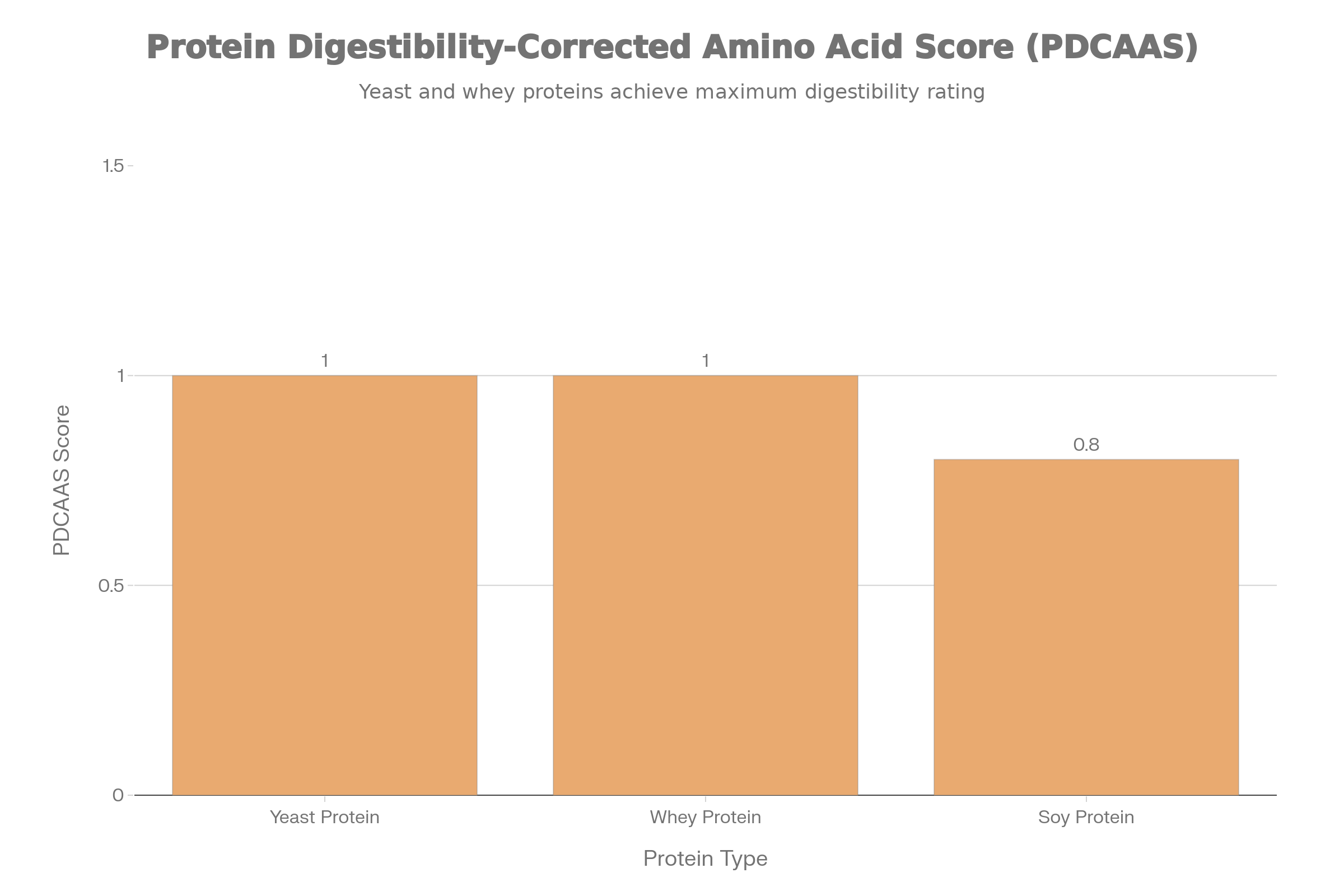
Protein quality varies dramatically between sources. Plant proteins like pea (PDCAAS 0.82) and soy (PDCAAS 0.91) contain limiting amino acids that reduce their biological value. Consumers seeking vegan options have historically had to compromise on protein quality.
The Solution:
Yeast Protein achieves PDCAAS 1.0—the maximum score on the FAO/WHO protein quality scale, identical to whey protein isolate and casein. A 2025 study in Food Chemistry confirmed that yeast protein's amino acid score (AAS) of 1.37 actually exceeds the reference pattern for adults over 3 years, meaning it provides essential amino acids in proportions that surpass minimum human requirements.
Formulation Insight:
PDCAAS 1.0 qualification allows "complete protein" claims and direct comparison with dairy proteins in marketing materials. For products targeting athletes, elderly consumers, or those with increased protein needs, this scientific validation provides compelling differentiation.
The Challenge:
Many alternative proteins suffer from poor digestibility due to anti-nutritional factors, fiber content, or complex protein structures. Low digestibility means amino acids are excreted rather than absorbed, reducing the effective protein value regardless of amino acid composition.
The Solution:
Research published in the Journal of Agricultural and Food Chemistry (2025) demonstrated that yeast protein achieves 97.66% true ileal digestibility—approaching whey protein isolate (WPI) levels and significantly exceeding soy protein isolate (SPI). The study utilized both in vivo rat models and the INFOGEST in vitro digestion protocol, providing robust validation across methodologies.
Formulation Insight:
High digestibility enables accurate protein content claims without discounting for bioavailability losses. Products can deliver the stated protein benefits more reliably than competitors using lower-digestibility alternatives.
The Challenge:
Branched-chain amino acids (leucine, isoleucine, valine) are critical for muscle protein synthesis, recovery, and athletic performance. Most vegan proteins contain significantly lower BCAA levels than dairy proteins, limiting their effectiveness for sports nutrition applications.
The Solution:
Yeast Protein 80% contains higher BCAA concentrations than whey protein concentrate. Manufacturer testing confirms elevated leucine, isoleucine, and valine content compared to both whey and soy baselines. This makes yeast protein particularly suitable for muscle synthesis, post-workout recovery, and athletic performance formulations.
Formulation Insight:
The high BCAA profile enables positioning directly against whey protein in the sports nutrition segment. Combined with vegan certification, this creates a unique value proposition for athletes seeking plant-based alternatives without compromising on amino acid quality.
%20content%20across%20yeast%2C%20whey%2C%20and%20soy%20proteins.png)
The Challenge:
Whey protein digests rapidly, causing a spike in blood amino acids followed by rapid clearance. While beneficial for immediate post-workout scenarios, this fast absorption can be suboptimal for sustained muscle protein synthesis, satiety, and weight management applications.
The Solution:
Yeast protein exhibits a slower digestion profile compared to whey. SHIME® (Simulator of Human Intestinal Microbial Ecosystem) testing demonstrates that yeast protein maintains higher concentrations of undigested protein through gastric and early intestinal phases, resulting in sustained amino acid release over extended periods.
Formulation Insight:
The slow-release profile makes yeast protein ideal for meal replacement products, nighttime recovery formulations, and weight management applications where prolonged satiety is desirable. Consider blending with whey for "fast + slow" protein systems that optimize both immediate and sustained amino acid delivery.
The Challenge:
Traditional protein concentrates and isolates strip away fiber during processing. While this maximizes protein content per gram, it eliminates the gut health benefits associated with dietary fiber and removes a key differentiation opportunity.
The Solution:
Yeast Protein 80% naturally contains approximately 10% dietary fiber—primarily beta-glucans and mannans from the yeast cell wall. These prebiotic fibers support gut microbiome health, enhance satiety, and provide additional functional benefits beyond pure protein delivery. Whey protein contains zero fiber.
Formulation Insight:
The fiber content enables additional label claims ("source of fiber," "supports digestive health") and creates synergy with probiotic formulations. For products targeting gut health, weight management, or holistic nutrition, the built-in fiber provides meaningful differentiation.
The Challenge:
The major protein sources all carry allergen burdens. Whey contains dairy allergens and lactose. Soy is among the top 8 allergens. Pea protein, while relatively safe, is produced in facilities that often handle other legumes and grains. These restrictions limit market reach and complicate manufacturing.
The Solution:
Yeast Protein 80% is completely free from the top allergens: no dairy, no gluten, no soy, no nuts, no eggs. This allergen-free status opens your products to consumers with lactose intolerance (65% of global population), celiac disease, soy allergies, and those following elimination diets.
Formulation Insight:
Allergen-free status simplifies supply chain management, reduces cross-contamination risks, and enables "free-from" marketing claims. For products targeting allergen-sensitive consumers, medical nutrition, or clean-label positioning, this is a significant competitive advantage.
Thenutritional quality of yeast protein has been validated through multiplepeer-reviewed studies utilizing both in vivo animal models andstandardized in vitro digestion protocols. These studies provide thescientific foundation for protein quality claims and demonstrate yeastprotein's competitive position against established protein sources.
Publication: Food Chemistry,Volume 463, January 2025
DOI: 10.1016/j.foodchem.2024.141178
Institution:Huazhong University of Science and Technology,China
Methodology: The study employed both growing SD rat models andthe INFOGEST standardized in vitro digestion protocol to evaluate yeastprotein (YPI from Saccharomyces cerevisiae) against whey proteinconcentrate (WPC), whey protein isolate (WPI), soy protein isolate (SPI), wheatprotein isolate (WhPI), and pea protein isolate (PPI).
Conclusion: "Yeast protein exhibits the highest ratio ofindispensable/dispensable amino acids (IAAs/DAAs, 0.91)... the yeast protein'sPDCAAS (100% for >3 years) surpassed those of plant proteins."
Publication: Journal of Agricultural and Food Chemistry, Volume 73, 2025
DOI: 10.1021/acs.jafc.5c06807
True ileal digestibility of 97.66%—closeto whey protein isolate and significantly higher than soy protein isolate. Thestudy confirmed that supplementation of yeast protein with either WPI or SPIachieved body weight gains comparable to casein, validating its use as aprimary protein source.
Publication: International Journal of Food Science andTechnology, Volume 60, 2025
Yeast protein supplement (YPS) achieved anamino acid score of 1.14—significantly higher than legume proteins (0.67-0.96)and even exceeding casein (1.13). The study concluded: "YPS containedhigher levels of essential amino acids, branched-chain amino acids, and dietaryfiber... contributing to superior protein quality indices, including amino acidscore and PDCAAS, surpassing even casein."
Our Yeast Protein 80% is manufactured in Japan under strict quality control protocols. The production facility maintains GMP (Good Manufacturing Practice) standards and employs comprehensive quality assurance systems to ensure batch-to-batch consistency.
• Japanese GMP Manufacturing: Facility operates under GMP protocols ensuring consistent quality
• Full Traceability: Complete documentation from raw material sourcing through finished product
• Batch Testing: Each production batch tested for protein content, amino acid profile, and microbiological safety
• Certificate of Analysis: CoA available for each shipment upon request
Saccharomyces cerevisiae (baker's/brewer's yeast) has a long history of safe use in food production spanning millennia. Yeast-derived proteins are recognized as safe food ingredients in major regulatory jurisdictions including USA (FDA GRAS), European Union, Japan, and other markets. The fermentation process produces a food-grade protein concentrate suitable for human consumption in dietary supplements, functional foods, and sports nutrition applications.
For decades, the protein conversation has been binary: animal proteins (whey, casein, egg) versus plant proteins (soy, pea, rice). Each category carries distinct trade-offs. Animal proteins deliver superior amino acid profiles and digestibility but raise concerns about allergens, sustainability, and ethical considerations. Plant proteins address sustainability and vegan demand but often compromise on protein quality, with limiting amino acids and lower digestibility.
Yeast protein represents a third category—microbial protein—that transcends this binary framework. Produced through controlled fermentation of Saccharomyces cerevisiae, yeast protein captures the nutritional advantages of animal proteins (complete amino acid profile, high digestibility, PDCAAS 1.0) while aligning with the sustainability and ethical benefits traditionally associated with plant proteins.
Saccharomyces cerevisiae—commonly known as baker's yeast or brewer's yeast—is among the most thoroughly studied organisms on Earth. Humans have cultivated this single-celled fungus for over 5,000 years, making it one of the earliest examples of biotechnology. Today, S. cerevisiae serves as the model organism for eukaryotic cell biology, with its complete genome sequenced in 1996.
What makes yeast remarkable for protein production is its metabolic efficiency. Given appropriate nutrients (primarily sugars from molasses or other carbohydrate sources), yeast cells rapidly multiply while synthesizing high-quality protein. The resulting biomass contains approximately 40-60% protein by dry weight, with an amino acid composition that naturally aligns with human nutritional requirements.
The protein extraction process isolates and concentrates this cellular protein, removing cell wall components while preserving the amino acid profile. The result—Yeast Protein 80%—delivers concentrated, high-quality protein suitable for human nutrition applications.
PDCAAS—Protein Digestibility-Corrected Amino Acid Score—is the internationally recognized method for evaluating protein quality, adopted by the FAO/WHO and used as the regulatory standard in the United States and many other countries. The score ranges from 0 to 1.0, with higher scores indicating higher protein quality.
PDCAAS incorporates two critical factors: (1) the amino acid composition of the protein relative to human requirements, specifically measuring the "limiting amino acid" (the essential amino acid present in the lowest proportion compared to needs), and (2) the true digestibility of the protein, accounting for how much is actually absorbed rather than excreted.
A PDCAAS of 1.0 represents the highest possible score—indicating that the protein contains all essential amino acids in proportions that meet or exceed human requirements, with high digestibility. Only a select group of proteins achieve this distinction: whey, casein, egg protein, soy protein isolate (in some measurements), and now yeast protein.
For formulators, PDCAAS 1.0 enables several important capabilities: (1) "complete protein" labeling claims, (2) accurate protein content declarations without quality discounts, (3) direct nutritional equivalence to dairy proteins in product positioning, and (4) regulatory compliance for protein quality claims in markets that require PDCAAS documentation.
While PDCAAS remains the regulatory standard in most markets, the FAO has proposed DIAAS (Digestible Indispensable Amino Acid Score) as a more refined measurement. DIAAS uses ileal digestibility (absorption at the end of the small intestine) rather than fecal digestibility, providing more accurate assessment of amino acid bioavailability.
Yeast protein performs well under both systems. Research shows DIAAS values of 82.42% for adults over 3 years—lower than the truncated PDCAAS of 100% but competitive with many protein sources and superior to most plant proteins. This dual validation provides confidence that yeast protein quality claims are robust across evolving regulatory frameworks.
Global protein production represents one of the most significant environmental challenges of our time. Livestock production alone accounts for approximately 14.5% of global greenhouse gas emissions—more than the entire transportation sector. Beef production requires roughly 20 times more land and emits 20 times more greenhouse gases per gram of protein compared to plant sources.
Even within the dairy industry, whey protein—despite being a byproduct of cheese production—carries environmental burden. The dairy cows producing the milk require feed (often from deforested land), generate methane emissions, and consume substantial water resources. As demand for whey protein grows independently of cheese consumption, the "byproduct" argument becomes increasingly strained.
Yeast protein production operates within a circular economy framework that dramatically reduces environmental impact. The process begins with molasses—a byproduct of sugar production from sugarcane or sugar beets. Rather than treating this material as waste, fermentation transforms it into high-value protein.
The fermentation cycle itself is highly efficient. Yeast cells double approximately every 90-120 minutes under optimal conditions, producing protein at rates impossible for animal agriculture. The entire production process—from inoculation to harvest—takes days rather than the months or years required to raise livestock.
After protein extraction, remaining yeast biomass returns to agricultural use as organic fertilizer, completing the circular loop. This closed-loop system minimizes waste, reduces land requirements, eliminates methane emissions from livestock, and operates independently of weather conditions or seasonal variations.
Consumer protein preferences are shifting dramatically. The "flexitarian" movement—consumers who primarily eat plant-based but occasionally include animal products—now represents the fastest-growing dietary segment in developed markets. These consumers seek the nutritional benefits of high-quality protein without the environmental and ethical concerns associated with intensive animal agriculture.
For this demographic, yeast protein offers an ideal solution: equivalent protein quality to whey, complete vegan certification, sustainability credentials, and allergen-free status. Products formulated with yeast protein can authentically claim "plant-based" positioning while delivering performance that matches dairy-based competitors.
The sports nutrition market—long dominated by whey protein—is experiencing significant disruption. Vegan athletes, lactose-intolerant consumers, and sustainability-conscious fitness enthusiasts increasingly demand alternatives that don't compromise on performance. Market research indicates the plant-based protein supplement segment is growing at over 8% annually, outpacing the broader protein supplement market.
Yeast protein addresses the primary weakness of plant-based sports nutrition: protein quality concerns. With PDCAAS 1.0 and higher BCAA content than whey, yeast protein enables brands to compete directly with dairy-based products on performance while capturing the growing vegan and sustainability-focused segments.
Mature sports nutrition markets with strong vegan demand, sustainability awareness, and premium price acceptance. Consumers actively seek "clean label" products with documented quality credentials.
Strong plant-based movement, high fitness culture participation, and consumers willing to pay premium prices for quality ingredients. "Made in Japan" carries positive quality associations.
Emerging fitness culture, growing supplement market, and strong demand for halal-eligible ingredients. Yeast protein's allergen-free status simplifies regulatory compliance.

Yeast Protein offers several advantages over whey: higher BCAA content, equivalent PDCAAS score (protein digestibility), and superior protein efficiency ratio. The key difference is digestion speed—yeast protein absorbs slower than whey, maintaining blood amino acid levels longer for sustained energy and satiety. It also contains 10% dietary fiber (absent in whey), supporting gut health alongside muscle nutrition.
Yes—Yeast Protein is 100% plant-based and ideal for vegan, vegetarian, and flexitarian products. Unlike soy protein, it offers complete amino acid profile comparable to animal proteins without common allergen concerns. As consumer demand shifts toward sustainable, non-meat protein sources due to health, environmental, and animal welfare concerns, yeast protein provides a clean-label solution for the growing alternative protein market.
Typical serving size is 20-30 grams per dose, delivering 16-24 grams of protein (at 80% protein content). For sports nutrition, 1-2 servings daily supports muscle maintenance and recovery. The slow digestion rate makes it excellent for meal replacement formulas where sustained satiety is desired. Dosage can be adjusted based on total daily protein targets and product positioning.
Versatile applications include sports nutrition powders and RTD beverages, vegan protein blends, meal replacement shakes, weight management products (sustained satiety benefit), protein bars and snacks, and senior nutrition formulas. The neutral taste profile allows easy flavoring, and good solubility supports both powder and beverage formats. Also suitable for food fortification in bakery and pasta products.


