Nannochloropsis is a marine microalgae - a tiny single-cell phytoplankton, about 2 to 5 microns across, that grows in seawater. As a finished ingredient it is supplied as a fine whole-cell powder: the entire algae cell is harvested, dried and milled, so nothing is stripped out. A single ingredient carries 61 naturally occurring nutrients, including vitamins, minerals, amino acids and unsaturated fatty acids. It is fully plant-based, suitable for vegan and vegetarian formulations.
What sets Nannochloropsis apart from other microalgae is its oil fraction. It is naturally rich in the omega-3 fatty acid EPA (eicosapentaenoic acid), at a level dramatically higher than other well-known algae.
The powder is a genuine whole-food matrix. Its 61 nutrients are grouped into five families:
This density lets a single SKU support a multi-nutrient story - omega-3, complete protein, immune and antioxidant components in one vegan powder.
EPA content is where Nannochloropsis stands out most. In the producer's data, its EPA level reaches approximately 5% - far above other popular microalgae:
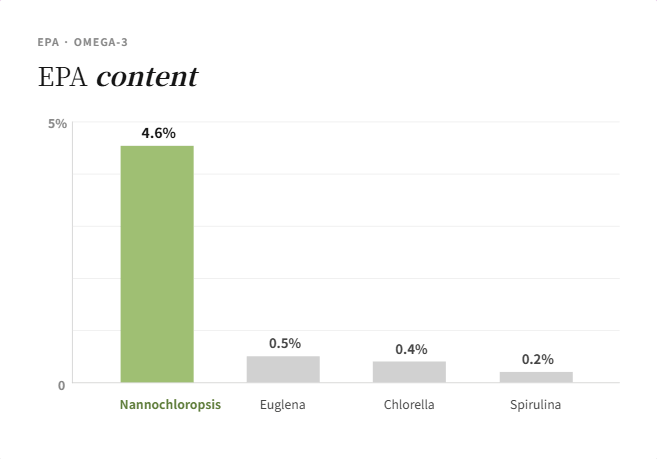
The EPA in Nannochloropsis is described as the phospholipid type (bound to phospholipids), which is water-dispersible - different from the glyceride-type EPA found in fish oil. Because it is algae-derived, this is a plant-based EPA: a vegan omega-3 with no fish, no marine sourcing and no fishy taste.
The same powder layers several further actives on top of its EPA:
Across the producer's comparison, Nannochloropsis leads the common functional microalgae on several measures:
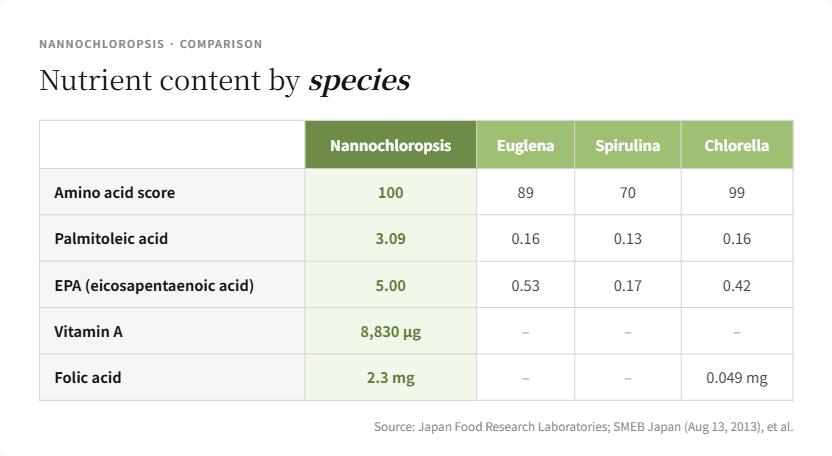
The takeaway for formulators: where spirulina and chlorella are valued mainly as green whole-food powders, Nannochloropsis adds a meaningful plant-based EPA omega-3 and omega-7 profile on top of complete protein.
This Nannochloropsis is cultivated in Okinawa, Japan, in a facility with roughly 2,500 m2 of cultivation pools - one of the largest of its kind in the country. Several production choices protect purity and consistency:
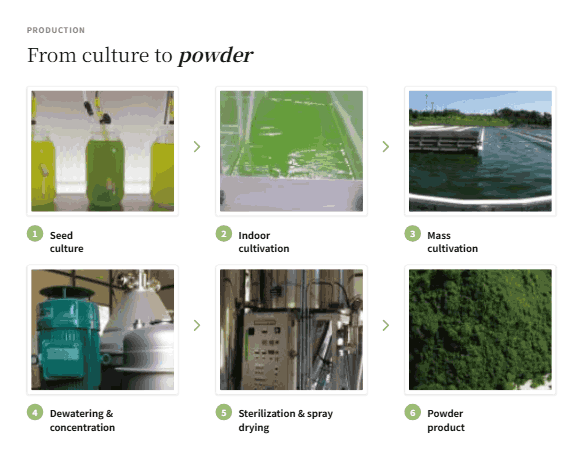
Production runs through six controlled stages: cultivation of the seed algae, indoor culture, large-scale culture, dewatering and concentration, sterilization and spray-drying, and the finished powder.
Nannochloropsis powder is a versatile, multi-application ingredient: functional foods and dietary supplements, health foods and everyday nutrition, cosmetics and skincare actives, aquaculture feed and seed stock, fertilizers, pharmaceutical applications, and biofuel feedstock.
This section draws on peer-reviewed research and current market data. Statements describe published findings on Nannochloropsis-derived EPA and on the individual nutrients; they are not claims that this powder treats or prevents any disease.
EPA (eicosapentaenoic acid) is a long-chain omega-3 most people associate with fish oil. The biological reality is the reverse: fish do not make EPA themselves. They accumulate it by eating microalgae at the base of the marine food chain. Nannochloropsis is one of those original EPA producers, which is why it can deliver the omega-3 directly, without the fish as an intermediary.
The form of the omega-3 also matters. In Nannochloropsis, much of the EPA is carried as polar lipids (phospholipids and galactolipids) rather than as the triglyceride form dominant in fish oil. Polar-lipid omega-3 is water-dispersible and is the form used in the clinically studied microalgal EPA ingredients. The comparative human bioavailability of phospholipid versus triglyceride omega-3 is still an active research question and not fully settled (Ghasemifard et al., Progress in Lipid Research, 2014), but the polar-lipid form is the basis of the most-studied algal-EPA supplements on the market.
A branded EPA-rich polar-lipid extract of Nannochloropsis - a concentrated oil, not whole-cell powder - has been studied in human trials, and the results are a useful reference point for the ingredient class:
An honest note for buyers: these trials used a concentrated EPA extract (over 25% EPA, over 15% polar lipids), whereas this product is the whole-cell powder that contains the same phospholipid-type EPA at a lower, food-level concentration. The research validates the EPA form and the absorption narrative; it does not transfer as a therapeutic claim onto the powder. Final EPA content should be confirmed against a current certificate of analysis.
The roughly 3 g per 100 g of palmitoleic acid (an omega-7 monounsaturated fatty acid) is a genuine secondary story. Published research has linked palmitoleic acid to anti-inflammatory activity (Sahoo et al., Journal of Lipid Research, 2024) and, in human and animal data, to lower blood pressure and reduced hypertension risk (Tang et al., Molecular Nutrition and Food Research, 2021). Omega-7 is also a recognised skin-barrier and cosmetic active. The metabolic picture is still mixed in the literature, so omega-7 is best positioned as a supporting, emerging-research nutrient rather than a primary clinical claim.
Plant-based EPA from microalgae carries a strong sustainability narrative, one of the most powerful tailwinds in the omega-3 category:
Demand for algae-derived omega-3 is growing quickly. Industry estimates put the algae omega-3 ingredient market at roughly 2.6 billion USD in 2025, with double-digit annual growth forecast through the early 2030s. Dietary supplements account for the largest share of use - about 58% - and the clearest growth driver is the shift toward plant-based, sustainable omega-3. A whole-food vegan microalgae with a naturally high EPA level, complete protein and a Japanese-origin purity story sits squarely in that current.
This Nannochloropsis powder is supplied directly from Japan in 1 kg sealed aluminum bags, suitable for sampling, R&D and scale-up, with multilingual support. It is a strong fit for vegan omega-3 supplements, whole-food greens blends, functional foods and beverages, and microalgae cosmetic actives, and can be taken into OEM/ODM finished formats.

Yes. Nannochloropsis is a marine microalgae and the powder is the whole dried algae cell, with no animal-derived material. It suits vegan and vegetarian formulations and provides a plant-based source of EPA omega-3.
Nannochloropsis is naturally rich in EPA (eicosapentaenoic acid) and is essentially an EPA-only omega-3 source. The body can convert EPA into DHA as needed, so an EPA-rich intake supports both.
It is plant-based rather than marine, and the EPA is carried largely in the phospholipid (polar-lipid) form, which is water-dispersible, rather than the triglyceride form typical of fish oil. There is no fishy taste and no reliance on wild fish stocks.
No. All three are functional microalgae, but Nannochloropsis carries a far higher level of EPA omega-3 and omega-7 (palmitoleic acid) than spirulina or chlorella, on top of a complete protein with an amino acid score of 100.


