The collagen ingredient market is mature, but most products on the global supply chain are essentially the same: collagen hydrolysates with average molecular weights of 2,000-10,000 Da, marketed under "low MW" or "rapid absorption" claims with little structural differentiation. R&D teams formulating premium beauty, joint or bone supplements increasingly run into the same wall: how to differentiate a product when every supplier sells "hydrolyzed marine collagen" at a similar specification.
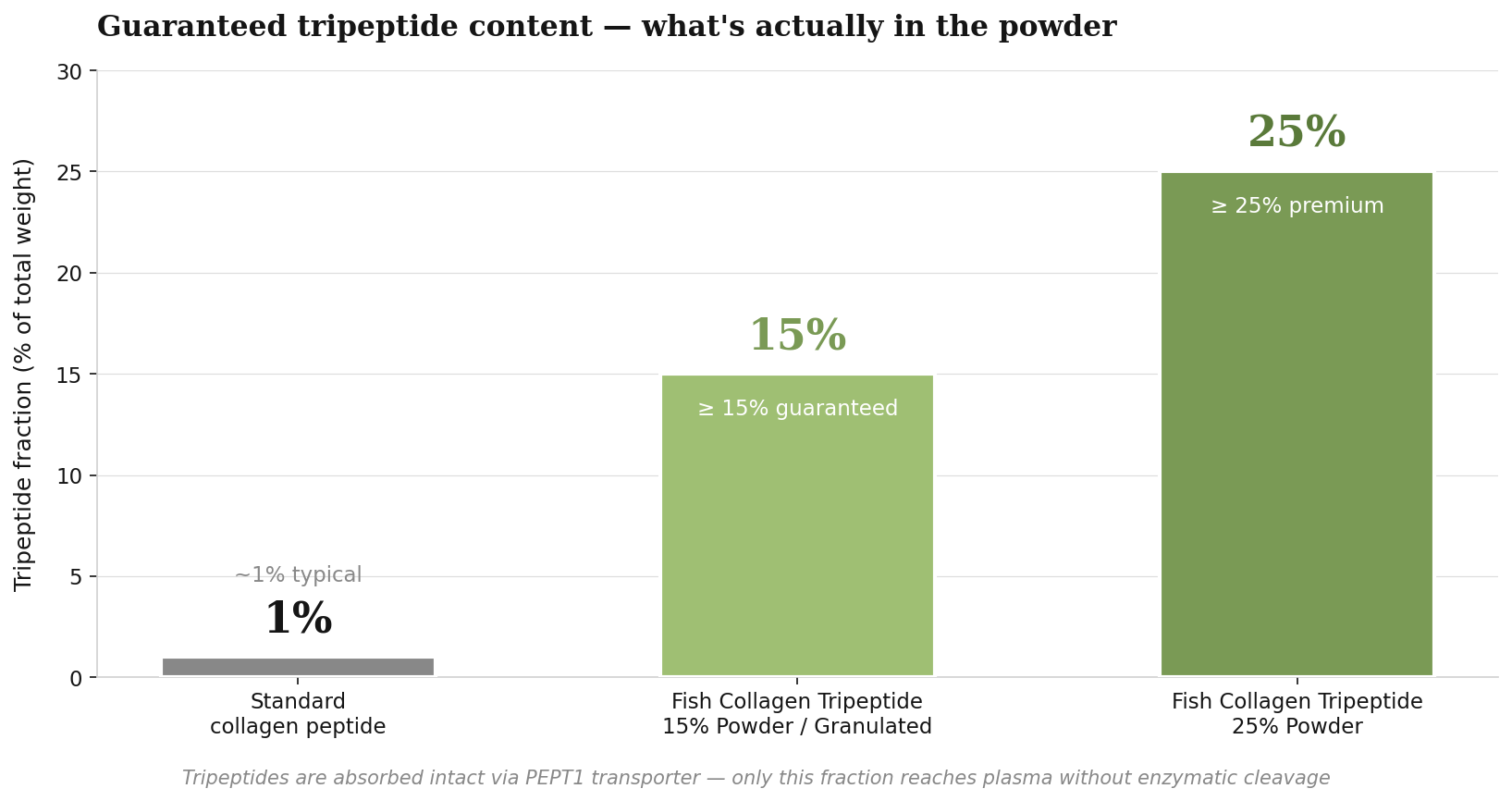
Fish Collagen Tripeptide solves this through a fundamentally different specification - not just lower molecular weight, but guaranteed tripeptide content. Standard collagen peptides contain approximately 1% tripeptide fraction. The Fish Collagen Tripeptide series guarantees ≥15% (the 15% Powder variant, the 15% Granulated variant) and ≥25% (the 25% Powder variant) of the bioactive tripeptide fraction, including the canonical Gly-Pro-Hyp and Pro-Hyp sequences responsible for measurable physiological effects.
Manufactured in Japan by a partner with over 84 years of collagen R&D heritage. The proprietary high-precision enzymatic hydrolysis process selectively cleaves collagen at specific sites to enrich the tripeptide fraction (Gly-X-Y), then purifies the result. Three SKUs cover the dominant supplement formats: standard powder, agglomerated granule, and high-concentration powder.
Most "low MW" collagen peptides marketed for bioavailability are sold by average molecular weight. The problem with this metric is that average MW does not predict bioactivity - what matters is the proportion of the peptide fraction small enough to be absorbed intact through the intestinal wall. The collagen tripeptide (CTP), composed of three amino acids in the canonical Gly-X-Y sequence, is the smallest functional unit of collagen and is absorbed directly without requiring enzymatic cleavage in the gut.
The Fish Collagen Tripeptide series quantifies and guarantees this fraction. The 15% Powder variant and the 15% Granulated variant contain ≥15% tripeptide content. The 25% Powder variant is enriched to ≥25%. By comparison, standard fish or porcine collagen peptides on the market typically contain approximately 1% tripeptide fraction - meaning that for the same gram-dose, this product delivers 15-25× more bioactive material to systemic circulation.
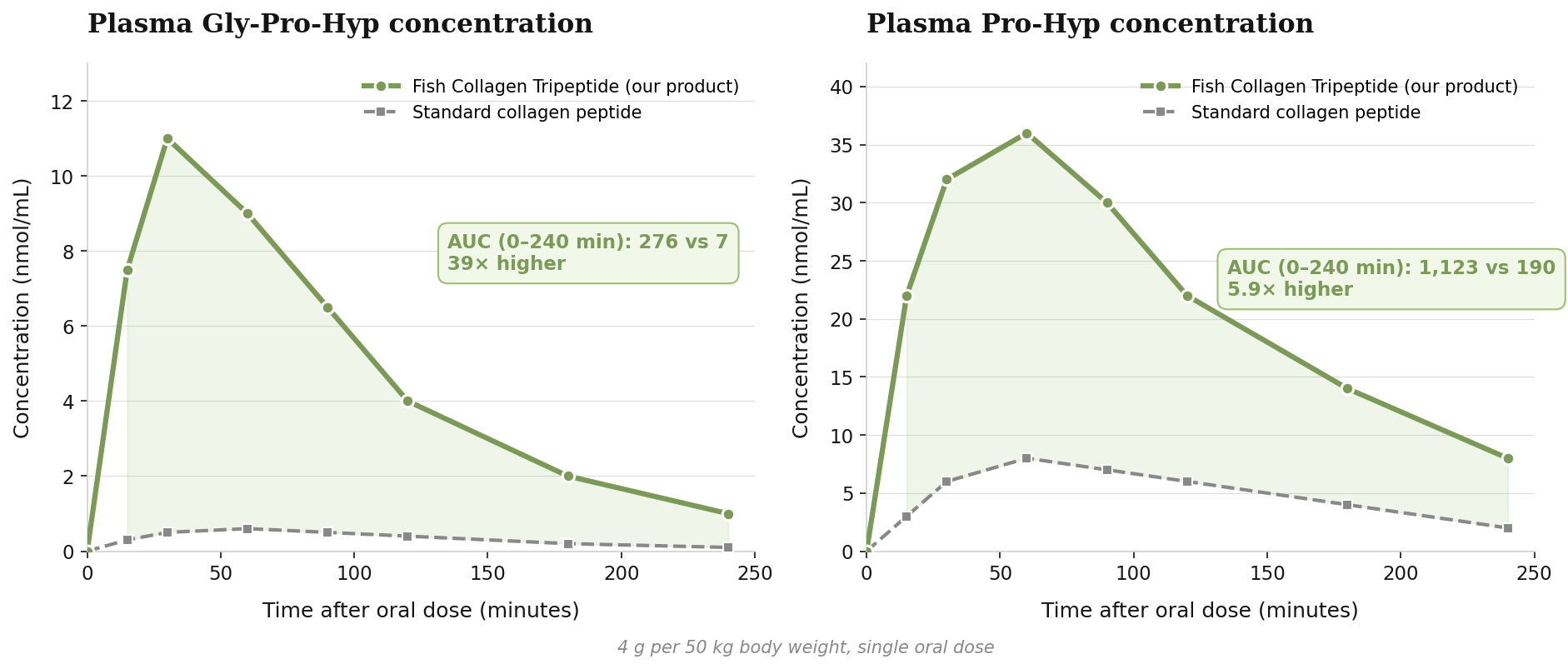
This translates into measurable pharmacokinetic differences. In a controlled human bioavailability study, plasma concentration of Gly-Pro-Hyp after a single oral dose (4 g per 50 kg body weight) was measured against a standard collagen peptide of average MW 5,000:
For supplement formulators, this changes the unit economics: at parity dose, finished products deliver dramatically more bioactive peptide to the bloodstream - supporting more confident efficacy claims and faster consumer-perceived results.
A second key differentiator is targeted tissue distribution. After absorption, these collagen tripeptides do not distribute uniformly through the body - they concentrate selectively in tissues where collagen is the structural protein: skin, periosteum, bone, bone marrow, cartilage and tendon.
Whole-body autoradiography studies (radiolabeled tripeptide, single oral dose) demonstrated this distribution at three time points: at day 1, accumulation in skin, periosteum, bone marrow, bone and partially the thymus; at day 5, kidney and Achilles tendon; at day 12, distribution throughout the spinal column and ribs. This profile explains why the product shows efficacy across diverse application areas - the same ingredient delivers active tripeptide to multiple connective-tissue targets through a single oral dose.
Skin and beauty. In normal human dermal fibroblasts, addition of collagen tripeptide produced approximately 3.4× increase in collagen synthesis at 3 mg/mL (with 1 µM Vitamin C cofactor) versus control. Hyaluronic acid production increased ~1.5× - comparable to or slightly above N-acetylglucosamine at the same concentration. In vivo (oral administration, mouse model), collagen tripeptide preparation produced significantly higher dermal collagen synthesis than four control conditions including standard collagen peptide and an equivalent amino acid mixture (P<0.001) - published in Preventive Nutrition and Food Science, Vol 17, p 245-253 (2012). UV-B-induced photoaging models showed dose-dependent reduction in wrinkle formation at 167 mg/kg and 333 mg/kg. Itch behavior in dry skin models was significantly reduced at 500 mg/kg dose - published in Journal of Dermatological Science, 66 (2012) 136-143.
Joints and tendons. In a rabbit knee osteoarthritis model, oral collagen tripeptide preparation significantly reduced cartilage surface degradation versus both untreated control and standard porcine collagen peptide - confirming that the effect is specific to the tripeptide fraction, not collagen amino acids generally. In a rat Achilles tendon injury model, CTP at 80 mg/kg accelerated tissue healing at 2 and 4 weeks (Azan and HE histological staining), with more organized fiber architecture in the CTP group - published in Pharmacometrics, 89 (3/6) p 115-124 (2015).
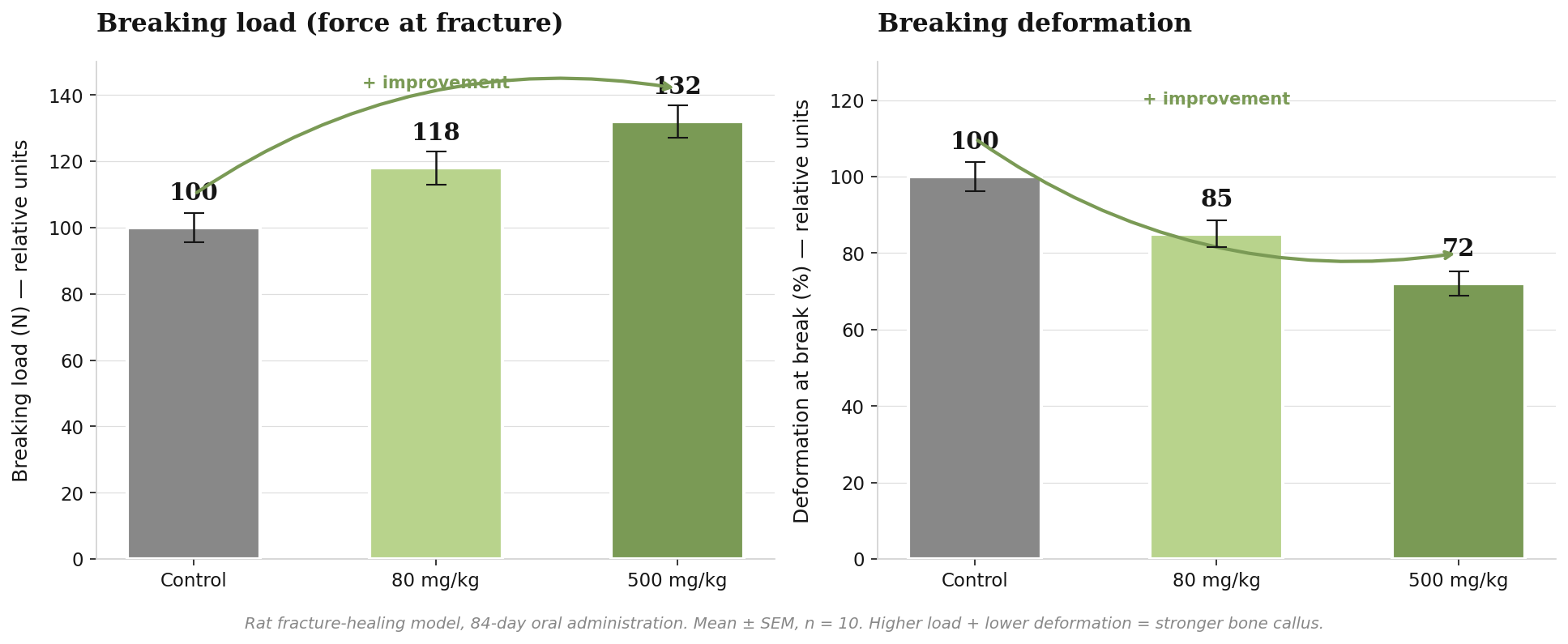
Bone health. A rat fracture healing model (84-day administration period) showed dose-dependent improvement in bone strength: tripeptide groups (80 mg/kg, 500 mg/kg) demonstrated reduced breaking deformation and increased breaking load versus control (Mean ± SEM, n=10). In human osteoblasts, the product increased COL1A1 gene expression and CICP secretion (C-terminal procollagen Type I peptide) in a dose-dependent manner across 0, 1, 3, 10 µg/mL concentrations.
Cardiovascular. In KHC rabbits (familial hypercholesterolemia and atherosclerosis model), oral collagen tripeptide preparation reduced atherosclerotic plaque formation, suppressed macrophage and aortic smooth muscle cell infiltration into plaques, and produced a statistically significant reduction in serum total cholesterol (P=0.022).
Beyond the manufacturer's preclinical and clinical data, the broader scientific literature on collagen tripeptides supports the bioavailability and efficacy framework. A 2024 randomized double-blind crossover study published in Frontiers in Nutrition (DOI: 10.3389/fnut.2024.1416643) compared bioavailability of skin- and hide-derived collagen hydrolysates from fish, porcine and bovine origins, confirming uptake of substantial amounts of hydroxyproline-containing di- and tripeptides - independent of source, but with measurable differences by molecular weight profile.
A 2024 single-center randomized double-blind clinical trial on a fish collagen tripeptide beverage (8 weeks, oral consumption) demonstrated significant improvements versus placebo: skin hydration increased 39.19%, transepidermal water loss decreased 33.45%, skin elasticity increased 25.37%, dermal collagen content increased 21.64%, pore size decreased 7.94%, and wrinkle length decreased 18.09%. A 2025 study in the Journal of Cosmetic Dermatology (DOI: 10.1111/jocd.70565) further documented the mechanism by which bioactive collagen peptides absorbed as di- and tripeptides reach the dermis, stimulate Type I and Type III collagen synthesis, regulate hyaluronic acid production, and inhibit MMP-mediated collagen degradation.
The 15% Powder variant - Standard powder, fish-skin origin, ≥15% tripeptide content. The workhorse SKU for general supplement applications: tablets, hard capsules, beverages, beauty drinks. 10 kg kraft bag packaging. Best when finished-product format requires fine powder dispersion.
The 15% Granulated variant - Granulated form of the 15% Powder variant, fish-skin origin, ≥15% tripeptide content. Excellent water solubility and rapid dispersion. 8 kg carton packaging. Best for instant-mix beverages, sticks, and effervescent formats.
The 25% Powder variant - High-concentration powder, fish-skin origin, ≥25% tripeptide content. Premium SKU for formulations requiring concentrated tripeptide delivery in smaller dose volumes. 10 kg kraft bag packaging. Best for premium-positioned beauty supplements, sports recovery and joint formulations where dose-per-capsule is a critical design constraint.
Appearance: White to pale yellow powder (granule for the 15% Granulated variant).
Odor: None or mild characteristic.
Taste: None or mild characteristic.
pH (10% solution): 6.0 - 8.5.
Bulk density: 0.23 - 0.35 g/mL.
Loss on drying: ≤ 8% (powder); ≤ 10% (granule).
Residue on ignition: ≤ 5%.
Heavy metals: ≤ 20 ppm.
Arsenic: ≤ 1 ppm.
Total plate count: ≤ 1,000 CFU/g.
Coliforms: Negative.
The Fish Collagen Tripeptide series integrates into all standard supplement and functional food formats: hard and soft capsules, tablets, sticks and sachets, beverages and beauty drinks, gummies, powder pre-mixes, fortified yogurts and dairy alternatives. The neutral organoleptic profile (no fishy odor or taste in finished products) supports flavor-sensitive beverage applications - a known formulation challenge with conventional marine collagen.
Recommended daily dose ranges from 2.5 g to 5 g of the 15% Powder variant or 15% Granulated variant, or 1.5 g to 3 g of the 25% Powder variant, for skin and beauty positioning. For joint, bone and cardiovascular positioning, dosage at the upper end of the range (5 g of the 15% Powder variant or 3 g of the 25% Powder variant) aligns with the doses used in the underlying bioavailability and efficacy studies.
Suggested formulation strategies:
Premium beauty-from-within stick (10 g serving): the 15% Granulated variant (5 g) + Vitamin C (200 mg) + hyaluronic acid (100 mg) + low-dose elastin (50 mg) - clean-label marine peptide stack with measurable absorption data, positioned at premium tier in functional beverage channels.
Joint and recovery capsule (4 capsules/day): the 25% Powder variant (1.5 g) + UC-II Type II collagen (40 mg) + boswellia (200 mg) + curcumin (250 mg) - high-tripeptide concentration in compact capsule format for sports and active-aging consumers.
Bone density formula (2-stick daily protocol): the 15% Powder variant (5 g) + calcium citrate (500 mg) + Vitamin D3 (1000 IU) + Vitamin K2 MK-7 (90 mcg) - comprehensive bone-support stack for post-menopausal and senior consumers.
The choice of collagen source increasingly carries strategic weight beyond formulation specifications. Bovine collagen continues to face periodic BSE and supply-chain concerns. Porcine collagen is excluded from halal, kosher, pescatarian, and significant Hindu-market segments - a meaningful constraint when the global Muslim consumer base alone exceeds 1.9 billion people, and beauty/supplement spend in MENA and Southeast Asia is among the fastest-growing globally.
Fish-derived collagen sidesteps these constraints. The fish-skin sourcing is suitable for halal, kosher, pescatarian and Hindu-market formulations. Combined with Japan-direct manufacturing and our Fish Collagen Tripeptide series' specific tripeptide content guarantee, this provides a structurally differentiated marine collagen position that commodity Chinese or Indian fish collagen cannot replicate.
Pricing is volume-tiered and structured to support both formulators ordering small R&D quantities and brand owners scaling production. All prices are EXW Japan (Takasaki, Gunma).
Variant5 kg (MOQ)10-50 kg (target)50-100 kg100+ kg15% Powder (≥15% tripeptide)150 USD/kg125 USD/kg115 USD/kg105 USD/kg15% Granulated Powder (≥15% tripeptide)175 USD/kg145 USD/kg135 USD/kg125 USD/kg25% Powder (≥25% tripeptide)320 USD/kg250 USD/kg225 USD/kg210 USD/kg
MOQ is 5 kg per SKU per order. Sample quantities (50-100 g) are available free of charge for qualified inquiries with verified company information and R&D contact. Sample quantities above 100 g are charged at the 1-kg sample rate (180 USD/kg for the 15% Powder variant, 210 USD/kg for the 15% Granulated variant, 400 USD/kg for the 25% Powder variant) plus shipping. Standard lead time is 4-6 weeks from order confirmation to FOB Japan for in-stock SKUs.
The Fish Collagen Tripeptide series is manufactured in Japan under HACCP-equivalent quality systems. Standard packaging is 10 kg kraft bag (the 15% Powder variant, the 25% Powder variant) and 8 kg carton (the 15% Granulated variant), with PE inner liner and 3-layer kraft outer. Shelf life is 36 months from production date when stored under recommended conditions. Iizuka Shoukai supplies our Fish Collagen Tripeptide series to formulators and brand owners in 26+ markets globally, with batch-specific Certificate of Analysis and direct manufacturer support for OEM and private label projects.
Request a sample, current price quote, and full technical documentation for the SKU that matches your application - we ship export-ready from Takasaki, Gunma, Japan.
Collagen is the most abundant structural protein in the human body, accounting for approximately 30% of total body protein. It forms the structural matrix of skin, bone, cartilage, tendon, ligament, blood vessel walls, and the extracellular matrix throughout the body. Native collagen is a triple-helix protein composed of approximately 3,000 amino acid residues, with a molecular weight in the range of 300,000 daltons. Hydrolyzed collagen, also called collagen peptide, is produced by enzymatic cleavage of native collagen into smaller fragments - typically 20-100 amino acid residues with molecular weights of 2,000-10,000 daltons.
The collagen tripeptide (CTP) is the smallest functional unit of collagen - three amino acid residues following the canonical Gly-X-Y sequence pattern that defines collagen's structural arrangement. Approximately one-third of all amino acids in collagen are glycine, with proline and hydroxyproline appearing in the X and Y positions to stabilize the triple helix. The tripeptide fraction is therefore the structural and functional minimum at which collagen retains its characteristic biology.
The collagen ingredient market commonly markets products by average molecular weight, with claims like "low molecular weight collagen" or "ultra-low MW peptides." This metric is misleading for two reasons.
First, average molecular weight is a single statistic about a distribution of peptides spanning a wide range of sizes. A product with average MW 1,000 daltons may contain a substantial fraction of larger peptides (5,000+ Da) that are not absorbed intact, balanced against very small fragments (less than 200 Da) that are essentially free amino acids. The average tells you nothing about the proportion of biologically active small peptides - di- and tripeptides - that the product actually delivers to circulation.
Second, only di- and tripeptides are absorbed across the intestinal epithelium intact via specific transporters (PEPT1) without requiring further enzymatic cleavage. Larger peptides must first be broken down by gut and brush-border enzymes into amino acids, di-, or tripeptides - a process that loses the peptide-specific bioactivity that drives skin, joint and bone effects. The bioactivity of collagen peptides is increasingly understood to derive from intact short peptides reaching tissue receptors and substrates, not from amino acid substrate effects.
This is why our Fish Collagen Tripeptide series specifies tripeptide content (≥15% to ≥25%) rather than only average MW. The guaranteed tripeptide fraction is what predicts absorption and tissue effect.
[VISUAL: diagram of intestinal absorption via PEPT1 transporter, intact tripeptide entering bloodstream]
After oral ingestion, the tripeptide fraction is absorbed across the intestinal wall via the PEPT1 transporter - the same transporter that handles dipeptide absorption from dietary protein. Intact tripeptides such as Gly-Pro-Hyp and the dipeptide Pro-Hyp are detected in plasma within 30-60 minutes of ingestion and reach measurable concentrations sufficient to interact with target tissues.
At the tissue level, collagen tripeptides exert effects through three primary mechanisms:
Mechanism 1 - Direct fibroblast and chondrocyte stimulation. In vitro studies on dermal fibroblasts and chondrocytes show that exposure to collagen tripeptides increases Type I collagen gene expression (COL1A1) and downstream collagen protein synthesis. The effect is dose-dependent and synergistic with cofactor support (Vitamin C). Critically, the same effect is not produced by an equivalent amino acid mixture - confirming that the bioactivity is peptide-specific, not nutritional.
Mechanism 2 - Selective tissue accumulation and matrix integration. Whole-body autoradiography studies show that absorbed collagen tripeptides selectively accumulate in skin, bone, periosteum, cartilage, tendon and bone marrow - the tissues where collagen is the structural protein. This selective distribution is not seen with free amino acids, suggesting tripeptide-specific recognition by tissues rich in collagen turnover.
Mechanism 3 - Modulation of matrix metalloproteinase (MMP) activity. Collagen-derived peptides reduce MMP-mediated degradation of existing collagen matrices in skin and connective tissue, shifting the balance toward net matrix preservation. Combined with increased synthesis (Mechanism 1), this produces a net positive effect on tissue integrity over time.
"Collagen peptide" is a broad term covering hydrolyzed collagen products with average molecular weights from approximately 2,000 to 10,000 daltons. These products contain a mixture of small peptides - typically 1% or less in the tripeptide fraction - alongside larger oligopeptides that require further enzymatic processing for absorption.
"Collagen tripeptide" refers specifically to products enriched in the bioactive tripeptide fraction (Gly-X-Y) through controlled enzymatic processing. The Fish Collagen Tripeptide series guarantees ≥15% to ≥25% tripeptide content - meaning that at the same gram-dose, the proportion of directly absorbable bioactive material is 15× to 25× greater than in conventional collagen peptide.
This distinction matters at three levels: bioavailability (more peptide reaches the bloodstream intact), efficacy (more peptide reaches target tissues), and dose efficiency (smaller doses can achieve equivalent or greater physiological effect than higher doses of standard collagen peptide).
The global collagen and gelatin market was valued at approximately USD 6.4 billion in 2024 and is projected to grow at a CAGR of 6.7% through 2030, with bioactive collagen peptides representing the fastest-growing segment within this category. Asia-Pacific is the largest regional market, driven by Japan, China, South Korea and Southeast Asia where ingestible beauty supplements are an established consumer category. North America and Europe represent the fastest-growing regions in absolute terms.
Marine and fish collagen is the fastest-growing collagen source category, with double-digit annual growth driven by halal market expansion, BSE concerns around bovine sources, and clean-label consumer preferences favoring marine over mammalian protein sources. Within marine collagen, the tripeptide-enriched segment commands a premium price position - typically 2× to 4× the per-kg price of standard fish collagen peptide - justified by the structural and bioavailability differences described above.
Marine-sourced collagen peptides occupy a strategically valuable position in the global supplement market. Bovine collagen - historically the dominant collagen source - periodically faces consumer concern around BSE and similar prion-related risks, with some markets imposing import restrictions on mammalian-derived collagen. Porcine collagen is fundamentally excluded from halal markets (~1.9 billion consumers globally) and kosher markets, and is incompatible with pescatarian, Hindu, and many vegetarian-adjacent product positionings.
Fish collagen, including our Fish Collagen Tripeptide series, is suitable for halal-positioning and kosher-positioning formulations, pescatarian diets, and most Hindu-market formulations. For brand owners building products intended for global distribution - particularly across MENA, Southeast Asia and growing diaspora markets in Europe and North America - marine sourcing is increasingly the default choice for collagen-based supplements and functional foods.
The Fish Collagen Tripeptide series has been documented across the standard food-ingredient safety battery. Acute oral toxicity testing produced negative results with LD50 exceeding 2,000 mg/kg body weight. A 28-day repeat-dose oral toxicity study tested low-dose (500 mg/kg) and high-dose (1,000 mg/kg) groups - both negative for adverse effects. Bacterial reverse mutation assay (Ames test variant) was negative. Allergy and antigenicity testing further confirmed the safety profile for use as a food ingredient.
The product is not a recognized allergen and does not require allergen labeling under most jurisdictions, although fish-derived ingredients are subject to general fish-allergen disclosure requirements in the EU, USA, Japan and several other markets. Manufacturers should follow standard label-disclosure practice for fish-derived ingredients.
Recommended storage is in a cool, dry, well-ventilated location protected from direct sunlight and high humidity. Standard ambient warehouse conditions are sufficient - no cold-chain logistics required. The product is hygroscopic; once a bag or carton is opened, transfer to a sealed moisture-barrier container for ongoing use to maintain quality. Shelf life is 36 months from production date in original sealed packaging.
[VISUAL: comparison table of standard collagen peptide ~1% vs 15% Powder ~15% vs 25% Powder ~25% tripeptide content]
【1】 Manufacturer bioavailability study, healthy adult volunteers, single oral dose at 4 g per 50 kg body weight. Plasma Gly-Pro-Hyp peaked at ~11 nmol/mL at 30 minutes versus negligible levels for standard collagen peptide. Plasma Pro-Hyp peaked at ~36 nmol/mL at 60 minutes. AUC (0-240 min): Gly-Pro-Hyp 276 vs 7 (standard); Pro-Hyp 1,123 vs 190.
【2】 In vitro fibroblast collagen synthesis study. Dose-response from 0 to 3 mg/mL collagen tripeptide with 1 µM Vitamin C cofactor. Approximately 3.4× increase in collagen production at 3 mg/mL versus control.
【3】 In vivo dermal collagen synthesis comparison (mouse model, oral administration). Five groups: control, untreated collagen, pepsin-hydrolyzed collagen peptide, equivalent amino acid mixture, and collagen tripeptide preparation. The tripeptide preparation produced significantly higher dermal collagen synthesis than all four control conditions (P<0.001). Publication: Preventive Nutrition and Food Science, Vol 17, p 245-253 (2012)
【4】 Itch-suppression study in dry skin mouse model. Scratching behavior counts (per 15 minutes): no treatment ~1; vehicle ~25; CTP 80 mg/kg ~20; CTP 500 mg/kg ~5 (significant reduction). Publication: Journal of Dermatological Science, 66 (2012) 136-143
【5】 Achilles tendon healing study, rat model. Collagen tripeptide preparation (80 mg/kg, oral) accelerated healing at 2-week and 4-week timepoints, with more organized fiber architecture in CTP group versus control. Publication: Pharmacometrics, 89 (3/6) p 115-124 (2015)
【6】 Independent randomized double-blind crossover study comparing bioavailability of fish, porcine and bovine collagen hydrolysates of varying molecular weight. Confirmed measurable plasma uptake of hydroxyproline-containing di- and tripeptides across all sources. Publication: Frontiers in Nutrition, Vol 11 (2024). DOI: 10.3389/fnut.2024.1416643
【7】 Independent single-center randomized double-blind clinical trial on fish collagen tripeptide beverage, 8-week intervention. Versus placebo: skin hydration +39.19%, transepidermal water loss -33.45%, skin elasticity +25.37%, dermal collagen content +21.64%, pore size -7.94%, wrinkle length -18.09%. (2024)
【8】 Independent randomized double-blind placebo-controlled study on bioactive collagen peptides and skin health, documenting di- and tripeptide absorption mechanism, Type I and Type III collagen synthesis stimulation, hyaluronic acid regulation, and MMP-mediated degradation inhibition. Publication: Journal of Cosmetic Dermatology (2025). DOI: 10.1111/jocd.70565
Standard fish collagen peptide contains approximately 1% tripeptide fraction; the rest is larger oligopeptides (2,000-10,000 daltons average MW) that require enzymatic breakdown in the gut before absorption. Fish Collagen Tripeptide guarantees 15-25% tripeptide content - peptides small enough to be absorbed intact across the intestinal wall via the PEPT1 transporter. In a controlled bioavailability study, plasma Gly-Pro-Hyp AUC was 39x higher with the tripeptide product than with standard collagen peptide; Pro-Hyp was 5.9x higher. At parity gram-dose, the product delivers dramatically more bioactive peptide to circulation, supporting more confident efficacy claims and faster consumer-perceived results.
MOQ is 5 kg per SKU per order. Iizuka Shoukai supplies three variants: 15% Powder at 125 USD/kg, 15% Granulated at 145 USD/kg, and 25% Powder at 250 USD/kg in the 10-50 kg target tier (EXW Japan). Volume tiers extend down to 105 USD/kg on the 15% Powder variant for orders above 100 kg. Sample quantities up to 100 g are free for qualified inquiries; larger samples bill at the 1-kg sample rate. Standard lead time is 4-6 weeks from order confirmation to FOB Japan. Shelf life is 36 months from production. Manufactured in Japan under HACCP-equivalent quality systems; batch-specific Certificate of Analysis included with every shipment.
For skin and beauty positioning, daily dose is 2.5-5 g of the 15% Powder or 15% Granulated variant, or 1.5-3 g of the 25% Powder variant. For joint, bone and cardiovascular positioning, dose toward the upper end aligns with the underlying efficacy studies (4 g per 50 kg body weight in human bioavailability work). The 15% Powder variant is the workhorse for tablets, capsules and beverages; the 15% Granulated variant gives faster water dispersion for instant-mix sticks and effervescent formats; the 25% Powder variant delivers higher tripeptide content per gram, useful when total capsule count is constrained. pH range 6.0-8.5; neutral organoleptic profile.
Japanese marine collagen ingredients are differentiated on three vectors that commodity Chinese or Indian fish collagen does not match. First, structural specification: the 15-25% guaranteed tripeptide content is the result of proprietary high-precision enzymatic hydrolysis from a Japanese manufacturer with over 84 years of collagen R&D heritage; commodity fish collagen is sold by average MW with no guaranteed tripeptide fraction. Second, manufacturing controls: HACCP-equivalent quality systems, batch-specific CoA, full traceability from fish-skin raw material to finished powder. Third, regulatory and clean-label fit: Iizuka Shoukai supplies export-ready documentation for halal, kosher and pescatarian positioning across 26+ markets.


