For decades, placenta extracts have been prized in the cosmetics industry for their regenerative and anti-aging properties. Yet over 99% of placenta-based ingredients come from animal sources—raising concerns about safety, ethics, and supply consistency. Rose Placenta Extract represents a paradigm shift: the world's first commercially available plant-derived placenta, developed through six years of research by Japanese scientists in collaboration with 10 international medical researchers.
Derived from the placenta tissue of Rosa damascena (Bulgarian Damask Rose)—the same rose species treasured for centuries in perfumery and traditional medicine—this patented ingredient harnesses the flower's natural regenerative mechanisms. The placenta region inside the rose, where seeds develop and receive nutrients, contains concentrated bioactive compounds that promote cellular renewal and protection.
What makes Rose Placenta Extract unique is its production method. Using patented cell culture technology (Japanese Patent JP5577443B2), manufacturer Ginza Tomato cultivates rose placenta cells under controlled stress conditions to maximize bioactive compound concentration. This process ensures year-round stable supply independent of seasonal harvests or weather conditions—a critical advantage for cosmetic manufacturers requiring consistent ingredient availability.
The result is an ingredient that delivers measurable efficacy: clinical testing demonstrates 125% increase in EGF (Epidermal Growth Factor) expression, 124% cell proliferation versus control, and antioxidant activity three times stronger than porcine placenta. These multi-pathway benefits make Rose Placenta Extract ideal for premium anti-aging serums, regenerative essences, brightening treatments, and professional skincare lines targeting discerning consumers who demand both performance and ethical sourcing.
Rose Placenta Extract delivers multi-pathway activity through a complex of bioactive compounds including polyphenols, flavonoids (primarily kaempferol and quercetin), and naturally-occurring growth factor precursors. Laboratory testing and published research demonstrate four primary mechanisms of action, each supporting specific cosmetic claims.
Epidermal Growth Factor (EGF) is a polypeptide whose discovery earned a Nobel Prize in Physiology or Medicine. EGF plays a critical role in skin cell proliferation, wound healing, and maintaining the skin's regenerative capacity—functions that decline significantly with age.
Rose Placenta Extract promotes the endogenous synthesis of growth factors within cells, rather than introducing exogenous factors from other organisms. This approach aligns with the body's natural renewal mechanisms, potentially offering more sustained benefits than topical EGF application alone.
Oxidative stress from UV exposure, pollution, and metabolic processes generates reactive oxygen species (ROS) that damage cellular structures, degrade collagen, and accelerate visible aging. Effective antioxidant protection is fundamental to modern anti-aging skincare strategies.
Rose Placenta Extract contains high concentrations of polyphenolic compounds from Rosa damascena, including flavonoids like kaempferol (comprising approximately 80% of the flavonoid content) and quercetin. These compounds demonstrate potent free radical scavenging activity through multiple mechanisms.
Research on Rosa damascena extracts has documented over 300 identified compounds with biological activity. The flavonoid content of approximately 16 g/kg dry weight provides substantial antioxidant capacity. Published studies confirm DPPH scavenging rates of 90-95.70% for damascena extracts.
Healthy skin renewal depends on the continuous proliferation of keratinocytes in the basal layer of the epidermis. As skin ages, this renewal rate slows, leading to thinner skin, delayed healing, and accumulation of damaged cells. Ingredients that support keratinocyte proliferation help maintain skin vitality and resilience.
The proliferative effect is believed to result from the combined action of growth factor stimulation and the protective effect of polyphenolic antioxidants, creating favorable conditions for cell division and tissue renewal.
Uneven skin tone, hyperpigmentation, and dark spots result from excess melanin production triggered by UV exposure, inflammation, and hormonal changes. Tyrosinase is the rate-limiting enzyme in melanin synthesis, making it a primary target for skin brightening ingredients.
Rose Placenta Extract demonstrates tyrosinase-inhibiting activity, helping to regulate melanin production at the enzymatic level. This approach addresses pigmentation concerns without harsh bleaching effects.
Rose Placenta Extract's efficacy is supported by a peer-reviewed publication in Archives of Plastic Surgery (2015), indexed in PubMed (PMC4659980). This in vivo study provides rigorous scientific validation beyond typical cosmetic ingredient testing.
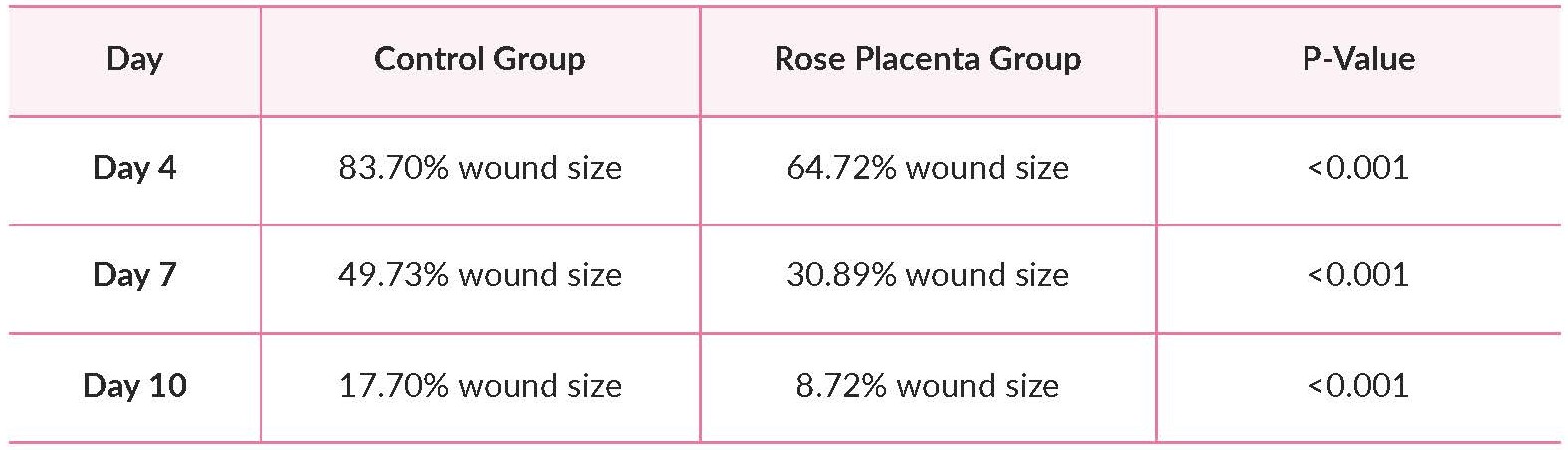
Rose placenta may potentially be a novel drug candidate for enhancing wound healing. — Archives of Plastic Surgery, 2015
While this study focused on wound healing, the demonstrated mechanisms—enhanced EGF production, improved cellular regeneration, and increased vascularization—are directly relevant to anti-aging skincare. These same biological processes underlie skin renewal, collagen synthesis support, and the maintenance of healthy, youthful-appearing skin.

Rose Placenta Extract Powder dissolves readily in the aqueous phase. For optimal results, dissolve in water or water-based phase at temperatures below 50°C (122°F) to preserve bioactive compound integrity. Add during the cool-down phase of emulsion preparation.
Stable across typical cosmetic pH range (4.5 - 7.0). For optimal stability and efficacy, formulate at pH 5.0 - 6.5.
In botanical terms, the placenta is the tissue inside a flower or fruit where seeds attach and receive nutrients during development. This region is metabolically highly active, containing concentrated growth factors, amino acids, and protective compounds that support rapid cell division and tissue formation.
While the term "placenta" is most commonly associated with mammalian reproduction, plant placentas serve an analogous function: they provide the essential nutrients and signaling molecules that enable new life to develop. This parallel inspired researchers to investigate whether plant placenta extracts could offer similar regenerative benefits for human skin.
The concept is not entirely new—traditional medicine systems have long recognized the value of seed-bearing plant tissues. However, modern extraction and cell culture technologies now allow us to concentrate and standardize these bioactive compounds for consistent cosmetic applications.
Rosa damascena, commonly known as the Damask rose, has been cultivated for over 2,000 years and holds a unique position in both perfumery and traditional medicine. Native to the region spanning Persia to Syria, it is now primarily cultivated in Bulgaria's Rose Valley, Turkey, and Iran.
Scientific analysis has identified over 300 compounds in Rosa damascena, including:
The total flavonoid content of approximately 16 g/kg dry weight is exceptionally high compared to many botanical sources, explaining the rose's potent antioxidant activity.
Epidermal Growth Factor (EGF) is a 53-amino acid polypeptide that plays a crucial role in regulating cell growth, proliferation, and differentiation. Its discovery by Stanley Cohen earned him the 1986 Nobel Prize in Physiology or Medicine, highlighting its fundamental importance to biology.
EGF production naturally declines with age, contributing to slower cell turnover, thinner skin, delayed healing, and reduced resilience. By age 50, EGF levels may be reduced by 50% or more compared to young adults. This decline makes EGF-promoting ingredients particularly valuable for mature skin formulations.
While some cosmetic products contain recombinant EGF (externally produced growth factor), Rose Placenta Extract takes a different approach: it stimulates the skin's own production of EGF. This endogenous activation may offer advantages in terms of biological compatibility and sustained effect, as the growth factors are produced by the body's own cells in response to botanical signaling compounds.
The global shift toward vegan and cruelty-free cosmetics represents one of the most significant trends in the beauty industry. This movement extends beyond dietary veganism to encompass a broader ethical and sustainability consciousness.
Traditional placenta extracts have delivered proven anti-aging benefits, making them popular in Asian markets particularly. However, animal-derived placenta presents challenges:
Rose Placenta Extract resolves this dilemma by delivering comparable or superior efficacy (3x antioxidant power) while meeting the ethical and safety requirements of modern conscious consumers. Brands can now offer placenta-level performance without compromising on values.
Japanese beauty (J-beauty) represents a philosophy of skincare that emphasizes prevention, gentle yet effective ingredients, and meticulous attention to quality. Japan's cosmetics industry is renowned for innovation, holding the largest market share for placenta-based products globally.
Rose Placenta Extract embodies these J-beauty values: developed through rigorous scientific research, manufactured with exacting Japanese quality standards, yet rooted in the traditional wisdom of rose-based skincare that spans millennia.
Our company is based in Japan and has been exporting high-quality raw materials and dietary supplements since 2022. We collaborate with leading manufacturers and develop products that are valued for their purity, safety, and effectiveness. We work with small and medium-sized businesses to help launch your brand or expand your product line.
Rose Placenta is a plant-derived extract from the placenta tissue of Bulgarian Damask Rose (Rosa damascena)—the nutrient-rich region inside the flower where seeds develop. Unlike animal placenta, which comprises over 99% of the placenta market, Rose Placenta offers a vegan, cruelty-free alternative with no risk of residual hormones or pathogens. Scientific testing demonstrates that Rose Placenta delivers 3x stronger antioxidant activity compared to porcine placenta, making it both ethically superior and more efficacious for antioxidant-focused formulations.
Rose Placenta Extract has demonstrated multiple efficacy benefits in scientific studies. Testing shows 125% increase in EGF expression in human fibroblast cells, supporting natural collagen synthesis. Cell proliferation studies found 124% growth in human keratinocytes at 5.0% concentration. Comparative antioxidant testing revealed 3x stronger free radical scavenging versus porcine placenta. The extract also demonstrates tyrosinase inhibition for even skin tone. A peer-reviewed wound healing study published in Archives of Plastic Surgery (PMC4659980) demonstrated accelerated healing with 2-fold higher EGF concentration. These multi-pathway actions make Rose Placenta Extract suitable for anti-aging, regeneration, and brightening formulations.
Rose Placenta Extract Powder can be incorporated at 0.5-5.0% concentration depending on the desired efficacy level and product type. For daily care products focusing on maintenance and antioxidant protection, use 0.5-1.0%. For treatment serums requiring significant EGF activation and regeneration, use 1.0-2.0%. For intensive treatments targeting maximum cell proliferation effect, use 3.0-5.0%. The water-soluble powder form with maltodextrin carrier allows easy incorporation into aqueous formulations including serums, essences, lotions, face masks, and cream emulsions. Add during the cool-down phase below 50°C for optimal bioactive preservation.
Yes, Rose Placenta Extract is ideal for clean beauty positioning. The ingredient is 100% plant-derived from Bulgarian Damask Rose and contains no animal-derived ingredients. No animal testing is required or conducted. Unlike animal placenta, there are no residual hormone concerns. The extract is free from 28 major allergens. The INCI name (Rosa Damascena Phytoplacenta Culture Extract) clearly identifies it as a plant extract, meeting clean beauty transparency standards and enabling vegan and cruelty-free product claims. This positions brands to address the $32.56 billion vegan cosmetics market.


